
CinemaEditor MAGAZINE

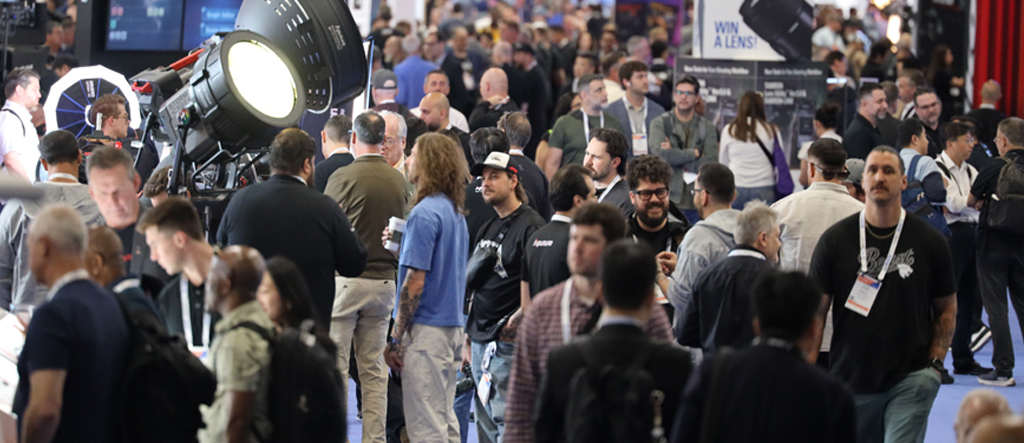
NAB Show convention floor. © 2026 National Association of Broadcasters. All rights reserved.
NAB Show Signals a “Maturity” in AI
Exhibitors at the Las Vegas confab discussed their approaches to AI and potential opportunities in production.
by Carolyn Giardina
AI remains a thorny subject in Hollywood and a central issue in labor negotiations, but at the recent NAB Show, it was the manufacturers’ turn to present their positions about the tech. “There’s a maturity that’s happening in AI,” said Avid Vice President of Product Management Guillaume Aubuchon, a message echoed by countless exhibitors across the show floor.
Sohonet CEO Chuck Parker didn’t mince words about the current climate. “Anyone who tells you they’re not using AI is either lying or just about to go out of business,” he asserted.
Attendance at the annual National Association of Broadcasters confab – this year held from April 18-22 in Las Vegas – underscored the evolving nature of the business. According to the NAB, the event attracted an estimated 58,000 registered attendees and 48% – nearly half – were first timers.
Across the exhibition floor, there were many startups to explore, as well as familiar stops such as the Avid booth. The Media Composer developer attracted crowds at its presentation theater, where Avid’s Matt Feury and Michael Krulik hosted presentations with several editors about their recent work, including Joel Negron, ACE, who presented Project Hail Mary alongside supervising sound editor/designer Erik Aadahl; Andy Jurgensen, who talked about his Oscar-winning work on One Battle After Another; and Nathan Schauf, editor of best animated feature Oscar winner KPop Demon Hunters.
Also in the presentation area, Krulik talked about Avid’s AI strategy, saying that editors and assistants “can build a workflow or extension for Media Composer,” meaning that editors can access AI applications without leaving Media Composer, using Flawless’ DeepEditor as an example.“It’s assistive AI. It’s a solution which creates visual dubs, allowing editors to change lines of dialogue after shooting,” he stated of DeepEditor, claiming, “Assistive AI is fundamentally different from generative AI, which is important. It’s built to support the artists and the editors, not replace them.” Krulik turned the mic over to Kevin Tent, ACE, who joined him on the stage, alongside Flawless customer success manager Hunter Woodworth.
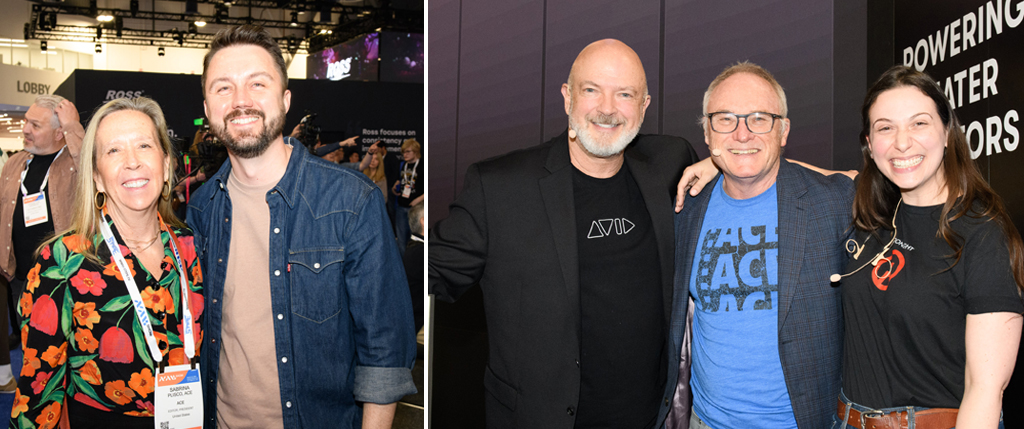
(L-R): ACE President Sabrina Plisco, ACE, with Editor Andy Jurgensen; Avid’s Michael Krulik, Editor Kevin Tent, ACE, and Hunter Woodworth from Flawless. Photos by Peter Zakhary.
“I am a big fan of this tool,” Tent said. “There are so many times where you have an off camera line that is actually better than what’s on camera, and this tool will allow you to take that line and put it in an actor’s mouth, which is pretty amazing, and lip syncing.
“We could always do something like this with visual effects. … but what’s great about Flawless is that you can upload the shot you want, and you’ll have it in an hour or so,” he continued. “It’s taking all the things that we’ve often used – like I often pull dialogue from other takes to get the right pronunciation of words, and I think most editors do that – but this is just taking that a step further.”
Tent added that particularly with comedies, “you could probably go a little nuts … It’s gonna make a lot of more work for editors, but we’re okay with that.”
Asked about responsible use of AI, Tent likened use of DeepEditor to a sort of “on camera ADR.” He explained, “In editing, we’re always adding lines. … so in a way, it’s the same thing. But that would have to get worked out with the cast. I would kind of think of it like temp music. We can cut with music all day long, but when it goes to finishing a film, we have to have the rights to that music, or we have to have it replaced by something that we can get the rights to.”
As an example of its use, Woodworth noted that DeepEditor was tapped for 2025 comedy Playdate. “The only way that it was able to be distributed on Amazon was reducing the rating,” she said. “So there were just a few moments where we were taking away some of the more vulgar lines. But instead of replacing them with like a ‘frick,’ the writers were able to make funny jokes, so that even though we were changing it and toning it down a little, it was still able to be a funny joke, not obviously censored.”
Aubuchon noted that Avid’s AI strategy in selecting partners such as Flawless is to identify developers “focused around an assistive editorial experience. … We’re focused on the professional editor, first and foremost, and delivering tooling into the application that makes them more efficient.”
A big component of Avid’s strategy is a new multi-year strategic partnership with Google Cloud, to integrate generative and agentic AI into Avid tools including Media Composer. “By embedding Google’s Gemini models and Vertex AI directly into Avid’s solutions, the collaboration aims to transform video editing from a mostly manual process into an intelligent, AI-assisted experience, significantly reducing the time required for media discovery and production.”
Aubuchon added that Avid is keeping up communication with Motion Picture Editors Guild (IATSE Local 700). “AI is here to stay,” he said, adding though that they don’t want to see jobs replaced by AI. “So we’re trying to find – I think that’s what we’re talking with 700 about – what is that line?”
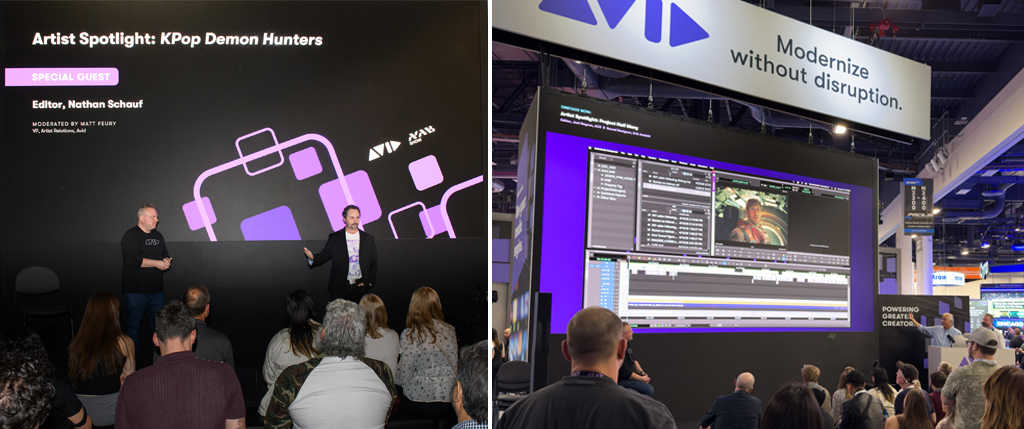
(L-R): Avid’s Matt Feury and editor Nathan Schauf; editor Joel Negron, ACE, and supervising sound editor/designer Erik Aadahl. Photos by Peter Zakhary.
Blackmagic Intros DaVinci Resolve 21
Blackmagic came to NAB with a collection of new tech including DaVinci Resolve 21, a new version of its editing/color grading/post-production software. It’s now in beta and available as a free download on the company’s website.
The company reported that the new version incorporates a number of new tools empowered by AI tech. Among them are AI IntelliSearch (search for people or objects), AI Speech Generator (transforms written text to spoken voice), and AI SlateID (to read slate and populate clip metadata).
AI Face Age Transformer gives artists a tool for aging or de-aging a face; AI Face Reshaper reshapes and resizes facial features; and AI Blemish Removal repairs skin blemishes.
New AI tools in DaVinci Resolve 21 also include AI CineFocus (bokeh and lens effects); AI UltraSharpen (high fidelity sharpening of moving images), AI Motion Deblur (removal of ‘common’ motion blur artifacts), AI Magic Mask (separately color grade different elements on an image); and AI SuperScale (upscale low resolution images).
Adobe’s Color Mode
Adobe was on hand at NAB to talk about AI as well as a new Color Mode. “We have completely reinvented the way that editors work with color in Premiere, purpose built for editors working with color,” said Adobe Director of Product Marketing Meagan Keane. “It’s enabling editors to have a more intuitive, sort of story-focused, creative approach to color versus the math and science of color.”
Keane noted that Color Mode could be used instead of or in addition to going to a final color grading suite. “Even for editors who are going to a final grade, they are expected to do so much in the editorial before it even goes to final color that they need these robust tools to be able to really manipulate color as much as they can in the edit.”
On the tool’s capabilities, she noted there are various ways to make adjustments. “You can take operations and you can apply them to a single clip, you can apply them to the entire sequence, or what I think is really exciting, you can apply them to a group of clips,” she said. “All of the new functionality we’ve been adding over the last couple years is all coming to fruition in terms of how editors can work with color in Color Mode.”
On the AI front, Adobe continues to expand access to AI models from within its Firefly app, the latest being integration with Kling 3.0 and Kling 3.0 Omni video AI models. Other integrations include Google’s Nano Banana 2 and Veo 3.1, Runway Gen-4.5, Luma AI’s Ray3.14, and ElevenLabs’ Multilingual v2.
“When you access those models through Firefly surfaces or Adobe Creative platforms like Photoshop or Premiere, your IP is protected,” Keane claimed, elaborating that “if you are accessing those models through an Adobe tool or through Firefly, contractually, they are not allowed to be training on any of the IP that is put through Adobe services. … As long as the creatives are able to hold onto their own IP, that’s really important for them to feel safe in sort of diving into these worlds of AI.”
Looking ahead, she acknowledges that “the models are going to keep leapfrogging each other … but what we’re now really seeing is that people are starting to tune into the workflow.”
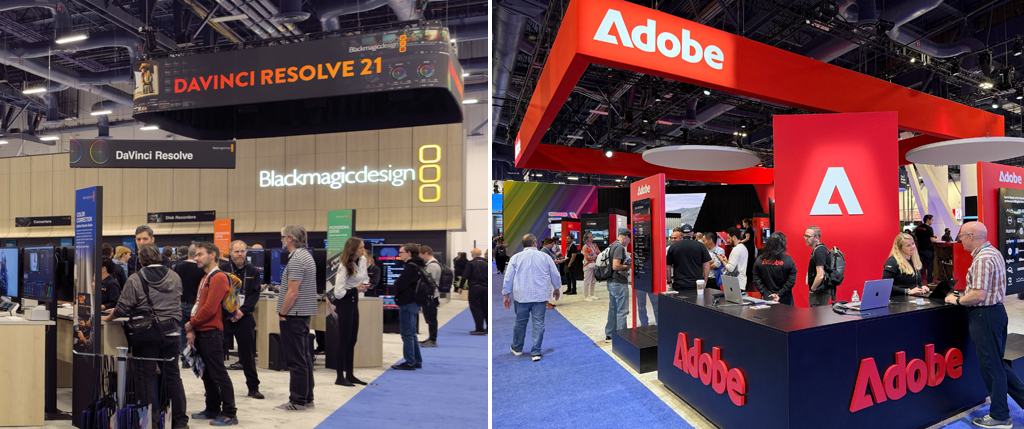
Blackmagic Design booth; Adobe booth. Photos by Peter Zakhary.
Strada’s Connect
Brothers Michael and Peter Cioni’s startup Strada, launched in 2023, is one such example of a company focused on workflow, including with AI capabilities. It arrived at NAB to introduce a new technology aimed at addressing the cost of cloud storage and time delays from file transfers. “The cloud is just too expensive for people to store original camera files,” Michael, the company’s CEO, asserted.
Strada Connect is aimed at supporting a workflow for remote teams who would instead of cloud, use their own local computer and storage. Michael explained that it’s developed to work directly in a computer’s Finder window. (Initially, it will be available on MacOS, with plans for Windows support at a later date.)
“We’re simply saying, stop doing the cloud thing. Just access the local stuff as if it were cloud through a peer-to-peer network,” Michael related, noting “you can do remote editing, remote sound mixing, remote color correction, remote photo editing, whatever.’
Sohonet’s Fabric
Also at NAB, Sohonet launched Media Fabric, a managed infrastructure that brings together networking, cloud access, security, and data movement (including Sohonet’s existing separate services) for postproduction. Aforementioned CEO Parker reported that these are effectively bespoke workflows that could be created for a handful of remote collaborators up to a large production.
He emphasized that Sohonet doesn’t dictate customers’ storage when setting up these workflows. “They can go buy their own NAS (network attached storage). They can get cloud storage from us or from somebody else. We just want to make sure that we can get the workflow up and running,” he said, adding that they work with all major cloud providers including AWS and could also set up a private cloud.
A key element of Media Fabric’s data movement capabilities is enabled by Sohonet’s new partnership with file transport software developer Resilio, which Parker likened to “Dropbox on steroids.”
On Sohonet’s AI strategy, Parker reported that “as a company, we use AI as much as we can” for uses such as automating its billing process.
“At the product level, we have a bunch of features we’re rolling out that are enhanced by AI. What we’re expecting AI to do as an impact on the industry is accelerate lots of things,” he related. “Since we have a lot of asset management, there’s a lot of interesting things that can happen around search and tagging and metadata. That’s the right play for Sohonet’s products.”
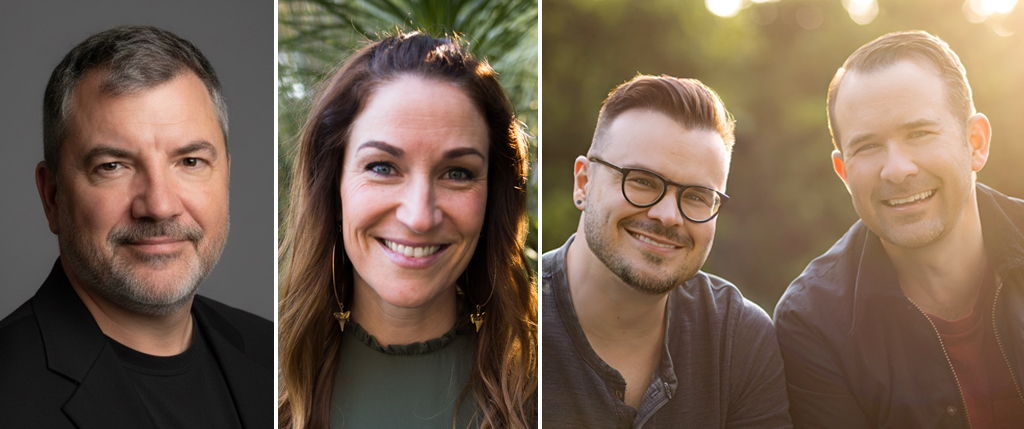
Top (L-R): Sohonet CEO Chuck Parker. Photo courtesy of Sohonet; Adobe’s Meagan Keane. Photo by Alminar Sagar; Michael and Peter Cioni from Strada. Photo courtesy of Strada.
Forward Looking
Despite the gloomy state of postproduction in L.A., Parker suggests there are some reasons for optimism. “We’re expecting a growth in video production, not just in classic TV and film, but in all the ‘nontraditional’ sources. We refer to things like creator economy. We talk about AI production studios, micro studios. There’s a lot happening.”
Speaking on a panel that explored the potential of verticals and micro-dramas, entertainment lawyer Dave Feldman, a co-founder and partner at Brecheen Feldman Breimer Silver & Thompson, suggested that “actors that are used to being on television shows and films, they’re going to look for quality writing, even in a micro-drama.”
This, he suggested, could lead to more opportunity. “If actors that are used to quality writing are interested in doing micro-dramas, I think good writing will come, and I think that’s what’s going to happen to micro-dramas. Inevitably, budgets are going to climb; studios willing to spend more,” he projected. “It’s going to evolve as another platform for programming to be distributed quicker, or they become like seeding for actual shows, testing.
“I do think that as it becomes popular … they are going to test the waters,” he added. “Some will work, some won’t, but they are going to look for higher quality material.”
"The Essence of Cinema is EDITING"