
CinemaEditor MAGAZINE

The End of Oak Street
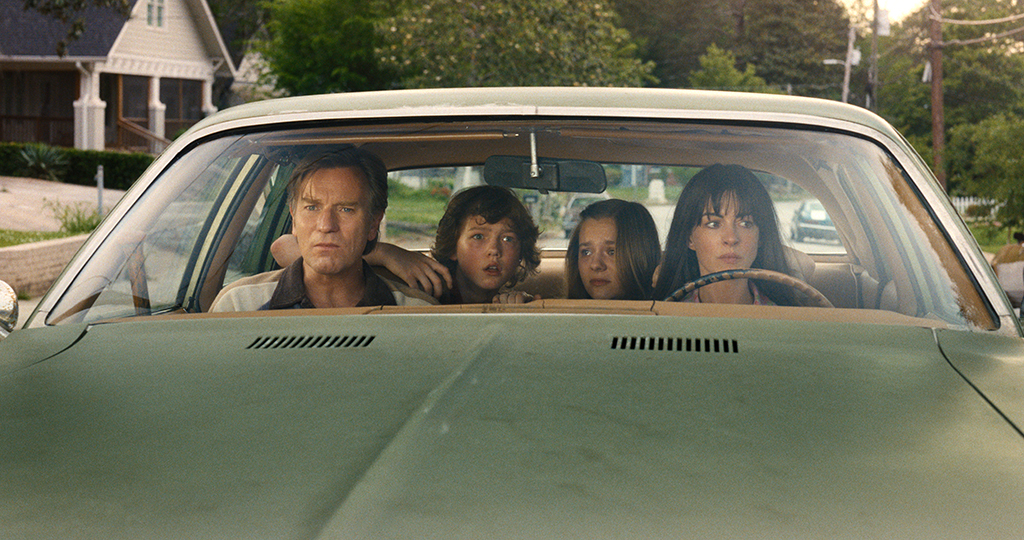
(L-R): Ewan McGregor, Christian Convery, Maisy Stella, and Anne Hathaway. Photo courtesy of Warner Bros. Pictures.
John Axelrad, ACE, Drives Exec Producer J.J. Abrams’ Summer Adventure
by Carolyn Giardina
Editor John Axelrad, ACE, describes his latest film, Warner Bros.’ The End of Oak Street, from exec producer J.J. Abrams’ Bad Robot, as “Amblin-esque,”with hints of classics such as Jurassic Park and Poltergeist. The film opened Aug. 14 and at press time already reached nearly $93.3 million at the worldwide box office.
Set in 1982, the story follows a family of four who find themselves fighting to survive when their neighborhood mysteriously transports to a different era where dinosaurs roam. The cast is led by Anne Hathaway and Ewan McGregor as Denise and Greg Platt, and Maisy Stella and Christian Convery as their children, Audrey and Brian.
Director and writer David Robert Mitchell has an affinity for films of this sort, notes Axelrad. “He has referenced Poltergeist as a big influence, as well as Jurassic Park and [even the classic] The Twilight Zone, and so we’d like to think of this film as a kind of homage to that type of filmmaking.”
The film has plenty of action as the humans are hunted by prehistoric creatures, but for Axelrad, “the most important thing in this film is the family dynamic. … If that doesn’t work, then the film just doesn’t work.”
And so the beginning of the movie focuses on introducing the family and their dynamics (and dysfunction). From there, he explains, “the arc of the film is to throw this family into complete chaos and into an extreme situation, where if they can pull through in the end, they’ll be a much more understanding, more trustworthy and communicating unit.”
After the viewer gets to know the family, a blackout occurs that transports Oak Street. But the film carefully reveals this information slowly, not all at once; Axelrad credits the director for this approach. “It was definitely David’s intention to slowly reveal that things were wrong,” he says. “That’s where this Twilight Zone style comes into play, where they’re slowly getting clued into the fact that things have changed around them.”
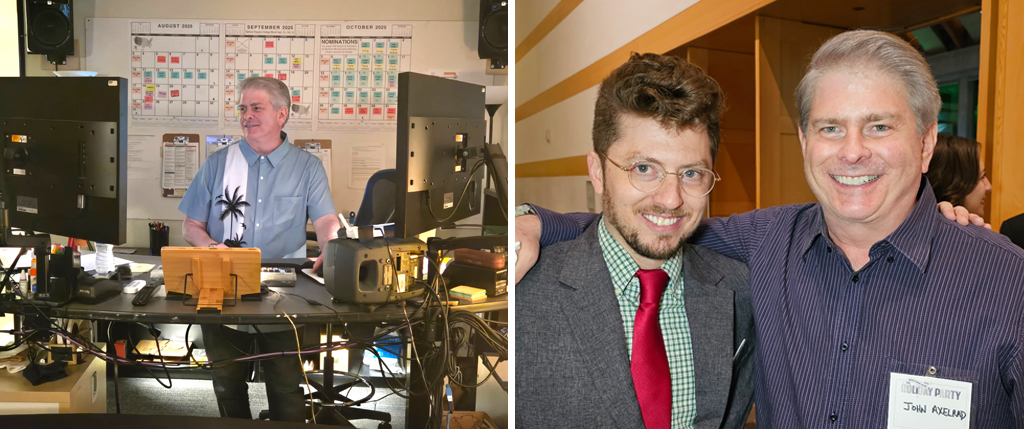
Left: Editor John Axelrad, ACE. Right: Axelrad with first assistant Z. Taylor Bynum IV. Photos courtesy of Mortimer Public Relations.
Following the blackout, the family wakes the following morning and are still without power. “Ewan and Anne’s characters go out looking for their dog while the kids stay inside, and they begin to discover some anomalies such as a geyser and some strange noises. Their daughter is still at home, and she’s hearing strange noises too, and then she thinks she sees something in the bushes. She gets her brother, and they run to investigate out different windows, and they see a tail of a dinosaur.
“The intent of that whole sequence was to intercut all of these characters as they’re experiencing this slow enlightenment that they’re not quite where they thought they were,” Axelrad explains, adding that they did build on this experience. “We restructured it from where the script was to really make it more impactful. And so things were modular and I was able to move scenes around to really keep the audience at the edge of their seat and to heighten the tension.” He adds that he was also careful not let the audience get too far ahead of the characters as information is revealed.
Axelrad gives much credit to Mitchell. “What reads great in the script doesn’t always translate to the screen, and that’s where you need a director who is open-minded and editors who are willing to try and experiment with different things.”
He cites as an example (minor spoiler) a sequence during which a Titanoboa (a giant prehistoric snake-like creature) gets into the house while the family is inside. Axelrad reports that this sequence as scripted occurred later in the movie, after the Platts realize where they have to go to make their escape. “I always felt that it wasn’t impactful [at that point in the story] because once they see the portal light in the distance and they know that they have to go after it, I just wanted them to pack their bags and go. That’s a perfect motivation for them to move.” The sequence with the creature, he says, seemed to slow things down, and so it was moved to an earlier point in the story.
Naturally, work also involved collaboration with the VFX team and handing off VFX sequences involving the digital dinosaurs as early as possible. Axelrad relates, “Normally we love to start chronologically and let the story build and work on the arc of the characters. But in this case, because we needed to give the post-vis VFX team enough time to work, we had to just hit all of these VFX sequences first.”
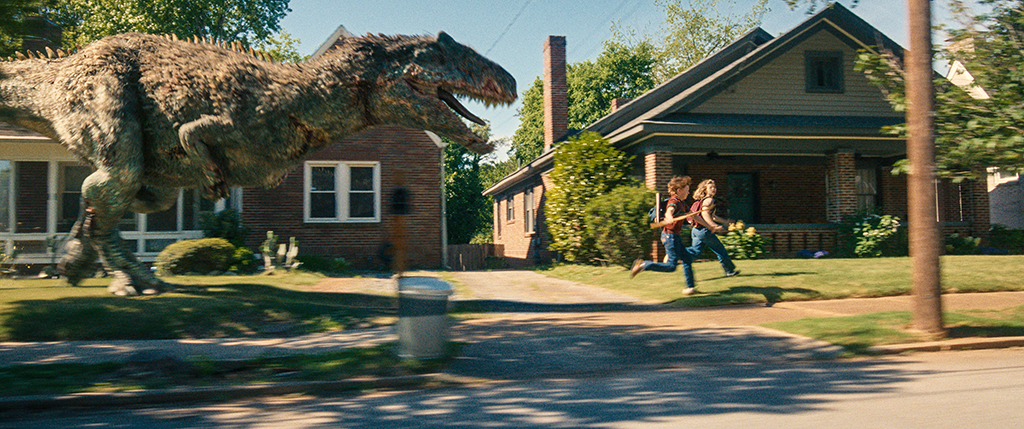
Christian Convery and Maisy Stella. Photo courtesy of Warner Bros. Pictures.
A less obvious use of VFX was needed after the crew did some additional filming, months after principal photography, and Convery, who played teen son Brian, was growing. “We were able to stitch in his new performance with his old performance and use visual effects to reduce him in size and to change his voice back to match what he sounded like when he was – I think he was 14 – when it was originally shot.”
Reflecting on the production, Axelrad says, “I just applaud Warner Bros. and Bad Robot for embracing the movie and letting David do his thing. … They said that they wanted to make a commercial movie that appealed to a lot of people – but in David’s style.” He adds that Mitchell “wrote a really taut script with this family going through these enormous changes, and finding happiness and peace, even though their environment is completely horrific and they may die at any moment. It was a progression as they begin to find love again and appreciation for one another – and also courage.”
This was Axelrad’s first time working with the director. He met Mitchell’s regular editor, Julio C. Perez IV, ACE, through Harry Yoon, ACE. Perez also worked on HBO series Euphoria and, with conflicting schedules, he was unavailable to cut The End of Oak Street, so he recommended Axelrad.
Axelrad – who mentors young editors through the ACE Internship Program – was grateful for the recommendation and notes that this is another example of editors supporting one another. “It’s very rewarding in that sense, and it was very nice to see others help me out in that situation to get this job,” he says.
“I’ve always been a champion of my assistants and mentoring them and getting them to high levels, and I am very proud of so many people.” He says that this includes a trio of former assistants that went on to earn Oscar nominations and two (Tom Cross, ACE, and Andrew Buckland, ACE) who won Academy Awards.
On The End of Oak Street, he proudly reports that his first assistant, Z. Taylor Bynum IV, earned an additional editor credit. And he commends the full team, including co-first assistant Dane Maddock, second assistant Sushant Chaudhary, second assistant/co-VFX editor Alyse Kollerbohm Kerr, VFX editor Pam Choules, post PAs Jessica Pradhan and Sara McClung, post supervisors Fady Hadid and Abby Callahan, post coordinators Spencer Terry and Ben Korduner, and music editor Paul Apelgren. ◼︎
"The Essence of Cinema is EDITING"