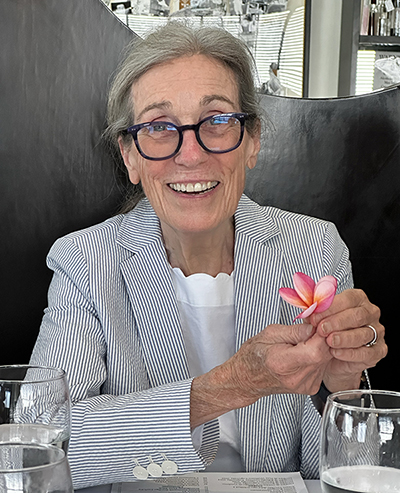
ACE Summer of Support Sundays

Just a friendly reminder about an exciting new initiative from the ACE Connect-Support Committee: Summer of Support Sundays. This program kicked off on Sunday, June 1st, and will run until EditFest Weekend (August 24th). It’s a free offering designed to help our community recharge and find some balance after the recent challenges.

Each week, ACE will be hosting mindfulness sessions. These valuable sessions will alternate between online and in-person, providing resources to help manage stress and promote overall well-being.

 
If you happen to miss a session or want to review the content, recordings and materials will be made available. This page will be updated weekly with the latest recordings.
 
You can find the full schedule and more details about upcoming events on the ACE Calendar HERE

Join Carolyn Barnes – clinical hypnotherapist, nationally recognized wellness expert, and former ABC TV health coach – as she guides through this powerful, science-backed mind-body reset workshop. This session blends hypnotherapy, NLP, somatic therapy, and the latest research in psychological resilience. 

Reset your nervous system, calm your mind, and reclaim clarity in the face of stress, creative pressure, and uncertainty. In a world that’s constantly shifting, one of the most powerful skills we can build is the ability to adapt our nervous systems — so we can respond to change with clarity, creativity, and resilience. 

Fear is a signal – not a stop sign. Learn to work with it, not against it: Interrupt fear-based thought patterns; Build inner safety through nervous system regulation:  and shift fear into clarity, courage, and calm action 

Watch the Replay: Revisit the session or share it with someone else by clicking the window below

Step-by-Step Tapping Guide + Audio to Release Stress

Download the EFT handout to follow along with a calming 7-minute guided audio. This tool walks you through Carolyn’s simple, body-based technique to release tension and reset your nervous system. You can use it anytime you feel overwhelmed, anxious, or stuck in your head.

Access the PDF with audio link HERE

Want More Free Tools?
If you’d like an additional guided audio to relax quickly, plus more mind-body tools:

Visit www.carolynbarnes.com
Scroll down to subscribe and access a second free calming audio.
You’ll also receive occasional support tools by email to help you stay grounded and focused.

Looking for Ongoing Support?
Here are two exclusive offers for ACE members:

1. Full Audio Library Access
Over 80 guided sessions for anxiety, confidence, sleep, and emotional balance
ACE rate: $11.11/month (regularly $27)
Use coupon code ACE at checkout: www.carolynbarnes.com/memberships

2. Free Strategy Session
Want personalized support? Book a free one-on-one session with Carolyn, (DISCOUNTS FOR ACE MEMBERS), to explore what’s next: https://calendly.com/carolynbarnes/55-min?month=2025-06

No pressure — just real support when you need it.

Join Carolyn Barnes for session 2 of her Resetting the Nervous System series: A mind-body reset to rewire mental patterns and emotional triggers. 

Using the “STOP IT: Overcome Overthinking in 6 Simple Steps” system, you can silence the spiral; rewire the habit; and regain clarity, calm, and control:

  • Learn how to interrupt looping thoughts and stop the mental spiral
  • Shift from overwhelm to relief using brain-based techniques
  • Strengthen your inner clarity and trust your next move.

Join Carolyn Barnes – clinical hypnotherapist, nationally recognized wellness expert, and former ABC TV health coach – as she guides through this powerful, science-backed mind-body reset workshop. This session blends hypnotherapy, NLP, somatic therapy, and the latest research in psychological resilience.

Watch the Replay: Revisit the session or share it with someone else by clicking the window below

Download the STOP IT Worksheet PDF. This worksheet is designed to help you begin applying the STOP IT method to interrupt the overthinking spiral, reconnect with your body, and reset your nervous system. Each step gives you space to reflect and notice what’s happening beneath the surface. Access the PDF HERE

Want More Free Tools?
If you’d like an additional guided audio to relax quickly, plus more mind-body tools:

Visit www.carolynbarnes.com
Scroll down to subscribe and access a second free calming audio.
You’ll also receive occasional support tools by email to help you stay grounded and focused.

Looking for Ongoing Support?
Here are two exclusive offers for ACE members:

1. Full Audio Library Access
Over 80 guided sessions for anxiety, confidence, sleep, and emotional balance
ACE rate: $11.11/month (regularly $27)
Use coupon code ACE at checkout: www.carolynbarnes.com/memberships

2. Free Strategy Session
Want personalized support? Book a free one-on-one session with Carolyn, (DISCOUNTS FOR ACE MEMBERS), to explore what’s next: https://calendly.com/carolynbarnes/55-min?month=2025-06

No pressure — just real support when you need it.

Yoga Nidra workshop led by guide Millie Heur

What is Yoga Nidra?
Yoga Nidra is a guided meditation practice that induces a deep state of relaxation and awareness. The practitioner’s state of mind is in a place between wakefulness and sleeping.

About Millie Heur
Millie Heur has taught Yoga Nidra to veterans through Veterans Yoga Project and to staff (for vicarious trauma and stress) and clients at the Trauma Recovery Center of the social services organization Homeless Outreach Integrated Care System. She has also taught the practice at Yogala Studio in Echo Park for six years.

Overview of practice
The Yoga Nidra guide/teacher takes the practitioners through a scripted journey that includes an entry, an intention setting for the practice, a rotation of consciousness (also known as a body scan), breath awareness, visualization, and a formal exit. Additionally, the guide/teacher can add poetry, mantra, and Metta meditation (also known as Loving Kindness), as they feel called.

The practice is done while the practitioner is lying comfortably on their back with support for the head and, if lying on the ground, support for the lower back by putting a pillow or bolster under the knees. It is advised that the practitioner use a blanket to cover their body as the body temperature can drop during the practice. It is important that the practitioner supported and comfortable so that they may “let go” into the practice.

Benefits of Yoga Nidra
Yoga Nidra is known to lessen the level of stress, improve sleep, help soothe the nervous system, and enhance overall wellbeing. It is an effective method for managing trauma and pain and has been used by veterans and first responders.

Join Carolyn Barnes for session 3 of her Resetting the Nervous System series: A mind-body reset to rewire mental patterns and emotional triggers. 

How to Actually Let Go: Release Emotional Resistance and Regulate Your Nervous System Fast
Release Trapped Emotions. Turn Off the Stress Response. Turn On Calm.
Most people make the biggest mistake when “letting go.” Instead of releasing, they drain their energy and reinforce self-limitations.

What you’ll learn:

  • Identify emotions, where stress lives in your body, and how it hijacks your thoughts
  • Neutralize and desensitize emotional triggers
  • Use breath, imagery, and sound to release stuck tension
  • Reset your nervous system in under five minutes — without willpower or overthinking

Join Carolyn Barnes – clinical hypnotherapist, nationally recognized wellness expert, and former ABC TV health coach – as she guides through this powerful, science-backed mind-body reset workshop. This session blends hypnotherapy, NLP, somatic therapy, and the latest research in psychological resilience.

Watch the Replay: Revisit the session or share it with someone else by clicking the window below

Want More Free Tools?
If you’d like an additional guided audio to relax quickly, plus more mind-body tools:

Visit www.carolynbarnes.com
Scroll down to subscribe and access a second free calming audio.
You’ll also receive occasional support tools by email to help you stay grounded and focused.

Looking for Ongoing Support?
Here are two exclusive offers for ACE members:

1. Full Audio Library Access
Over 80 guided sessions for anxiety, confidence, sleep, and emotional balance
ACE rate: $11.11/month (regularly $27)
Use coupon code ACE at checkout: www.carolynbarnes.com/memberships

2. Free Strategy Session
Want personalized support? Book a free one-on-one session with Carolyn, (DISCOUNTS FOR ACE MEMBERS), to explore what’s next: https://calendly.com/carolynbarnes/55-min?month=2025-06

No pressure — just real support when you need it.

Join Carolyn Barnes for session 4 of her Resetting the Nervous System series: A mind-body reset to rewire mental patterns and emotional triggers. 

Trust Yourself Again: Nervous System Repair for Clarity, Confidence & Creative Flow
After high stress or burnout, the nervous system doesn’t just bounce back it stays on high alert. This session dives into the real reason we get stuck in over- thinking, self-doubt, or creative paralysis and how to rewire those patterns from the inside out. Using brain-body techniques and somatic tools, attendees will learn how to move from protection mode into aligned, confident action.

What you’ll walk away with:

  • Why stress and uncertainty block self-trust and decision-making
  • How to reset your emotional baseline to create clarity under pressure
  • A practical method for restoring creative flow and grounded confidence

Join Carolyn Barnes – clinical hypnotherapist, nationally recognized wellness expert, and former ABC TV health coach – as she guides through this powerful, science-backed mind-body reset workshop. This session blends hypnotherapy, NLP, somatic therapy, and the latest research in psychological resilience.

Watch the Replay: Revisit the session or share it with someone else by clicking the window below

Want More Free Tools?
If you’d like an additional guided audio to relax quickly, plus more mind-body tools:

Visit www.carolynbarnes.com
Scroll down to subscribe and access a second free calming audio.
You’ll also receive occasional support tools by email to help you stay grounded and focused.

Looking for Ongoing Support?
Here are two exclusive offers for ACE members:

1. Full Audio Library Access
Over 80 guided sessions for anxiety, confidence, sleep, and emotional balance
ACE rate: $11.11/month (regularly $27)
Use coupon code ACE at checkout: www.carolynbarnes.com/memberships

2. Free Strategy Session
Want personalized support? Book a free one-on-one session with Carolyn, (DISCOUNTS FOR ACE MEMBERS), to explore what’s next: https://calendly.com/carolynbarnes/55-min?month=2025-06

No pressure — just real support when you need it.

Join Carolyn Barnes for session 5 of her Resetting the Nervous System series: A mind-body reset to rewire mental patterns and emotional triggers. 

Releasing Anger + Resentment: Emotional Detox for Real Relief
Unexpressed anger becomes chronic stress. Release it safely – and reset.

What you’ll learn:

  • Identify where anger and resentment live in the body
  • Rewire your response to emotional pressure
  • Let go of what’s heavy to make room for clarity and power

Join Carolyn Barnes – clinical hypnotherapist, nationally recognized wellness expert, and former ABC TV health coach – as she guides through this powerful, science-backed mind-body reset workshop. This session blends hypnotherapy, NLP, somatic therapy, and the latest research in psychological resilience.

Watch the Replay: Revisit the session or share it with someone else by clicking the window below

Want More Free Tools?
If you’d like an additional guided audio to relax quickly, plus more mind-body tools:

Visit www.carolynbarnes.com
Scroll down to subscribe and access a second free calming audio.
You’ll also receive occasional support tools by email to help you stay grounded and focused.

Looking for Ongoing Support?
Here are two exclusive offers for ACE members:

1. Full Audio Library Access
Over 80 guided sessions for anxiety, confidence, sleep, and emotional balance
ACE rate: $11.11/month (regularly $27)
Use coupon code ACE at checkout: www.carolynbarnes.com/memberships

2. Free Strategy Session
Want personalized support? Book a free one-on-one session with Carolyn, (DISCOUNTS FOR ACE MEMBERS), to explore what’s next: https://calendly.com/carolynbarnes/55-min?month=2025-06

No pressure — just real support when you need it.

Join Carolyn Barnes for session 6 of her Resetting the Nervous System series: A mind-body reset to rewire mental patterns and emotional triggers. 

Transforming procrastination into self-motivation
Procrastination is unprocessed resistance – learn how to use it as fuel.

What you’ll learn:

  • Recognize how avoidance shows up in your body
  • Shift pressure into purpose
  • Build identity-based momentum

Join Carolyn Barnes – clinical hypnotherapist, nationally recognized wellness expert, and former ABC TV health coach – as she guides through this powerful, science-backed mind-body reset workshop. This session blends hypnotherapy, NLP, somatic therapy, and the latest research in psychological resilience.

Watch the Replay: Revisit the session or share it with someone else by clicking the window below

Want More Free Tools?
If you’d like an additional guided audio to relax quickly, plus more mind-body tools:

Visit www.carolynbarnes.com
Scroll down to subscribe and access a second free calming audio.
You’ll also receive occasional support tools by email to help you stay grounded and focused.

Looking for Ongoing Support?
Here are two exclusive offers for ACE members:

1. Full Audio Library Access
Over 80 guided sessions for anxiety, confidence, sleep, and emotional balance
ACE rate: $11.11/month (regularly $27)
Use coupon code ACE at checkout: www.carolynbarnes.com/memberships

2. Free Strategy Session
Want personalized support? Book a free one-on-one session with Carolyn, (DISCOUNTS FOR ACE MEMBERS), to explore what’s next: https://calendly.com/carolynbarnes/55-min?month=2025-06

No pressure — just real support when you need it.
Everything’s Coming Up Roses

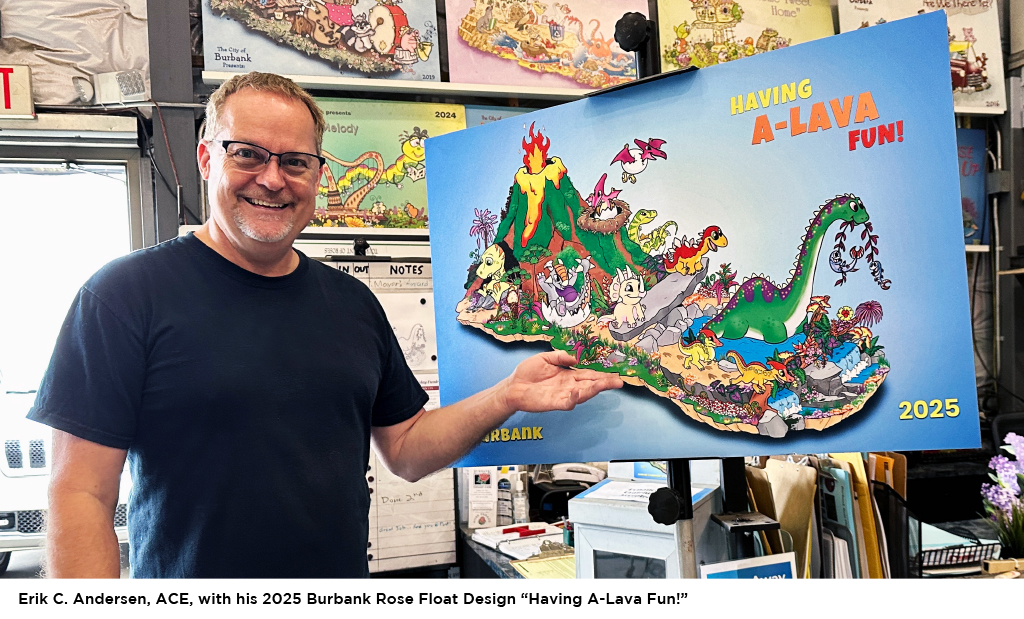
ERIK C. ANDERSEN, ACE, AND HIS DECADES LONG WORK WITH BURBANK ROSE PARADE FLOATS

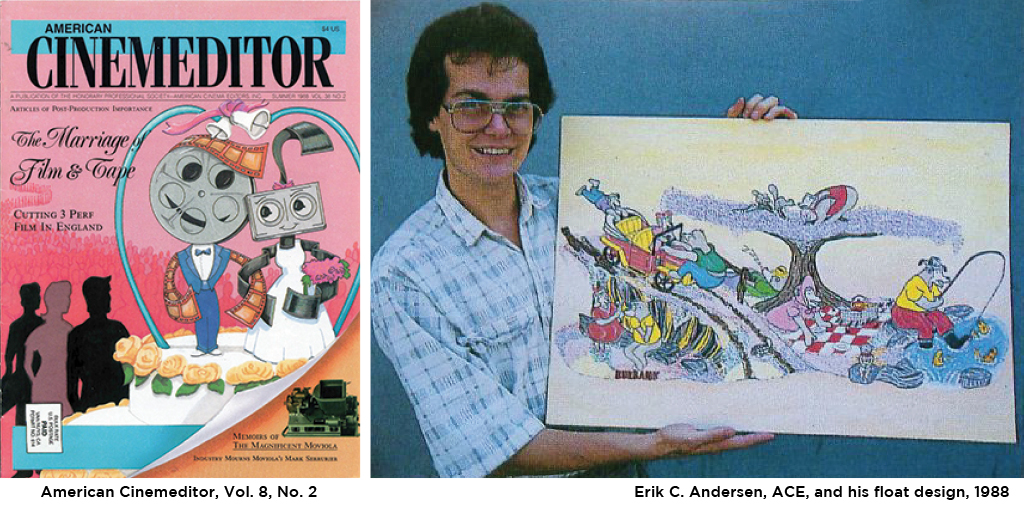
Back in 1988, I had the incredible honor of being featured in the American Cinemeditor Magazine (Volume 38 Number 02). At the time, I was just starting my career in the film industry as a sales representative for Christy’s Editorial Film Supply, a company known for renting and selling post-production film equipment and supplies. Denise Abbott spotlighted me in the “Scene and Heard” column, all because I had designed the Burbank Rose Float, “The Unforgettable Picnic,” for the 100th Pasadena Tournament of Roses Parade. 

Fast forward 36 years, I am now a proud member of the American Cinema Editors and once again the designer of Burbank’s Rose Float for the 2025 Rose Parade, this time titled “Having A-Lava Fun!” The float depicts a playful scene of over a dozen whimsical baby dinosaurs frolicking in a vibrant floral landscape under the shadow of a Volcano. Follow the float construction on Facebook at www.facebook.com/BurbankRoseFloat

Check out a road test of the 2025 float HERE

YOUR CHANCE TO WORK ON THE 2025 FLOAT IS HERE

With 43 years of float decorating experience, Erik C. Andersen, ACE, is inviting ACE, members and their families to work on the float Deco Week (Dec. 26 to Dec. 31st from 10am to 10pm). Text Erik at (818) 458-6357 or email him at editor@filmsinfocus.com if you’re interested in volunteering.

Float Barn Construction & Decoration Site Burbank Water and Power, 123 W. Olive Ave., Burbank, CA 91502, Float Barn phone (818) 840-0060. Parking is available at the Metro Link next to the float barn under the Olive (5 Fwy) overpass . 

Save time by filling out the release form before you arrive. http://burbankrosefloat.com/release-forms.html 

For more info: http://burbankrosefloat.com/index.html 

Wear warm clothes that you don’t mind getting dirty. Also show your spirit by wearing your ACE swag. 

Don’t want to get your hands dirty? Then come down on Dec. 31 for the 2:00pm float judging. It’s a great time to see the animation running, hear the music, and get a close-up look at the flowers on the float. 

New York Stories

Episode 11: The Making of A House of Dynamite

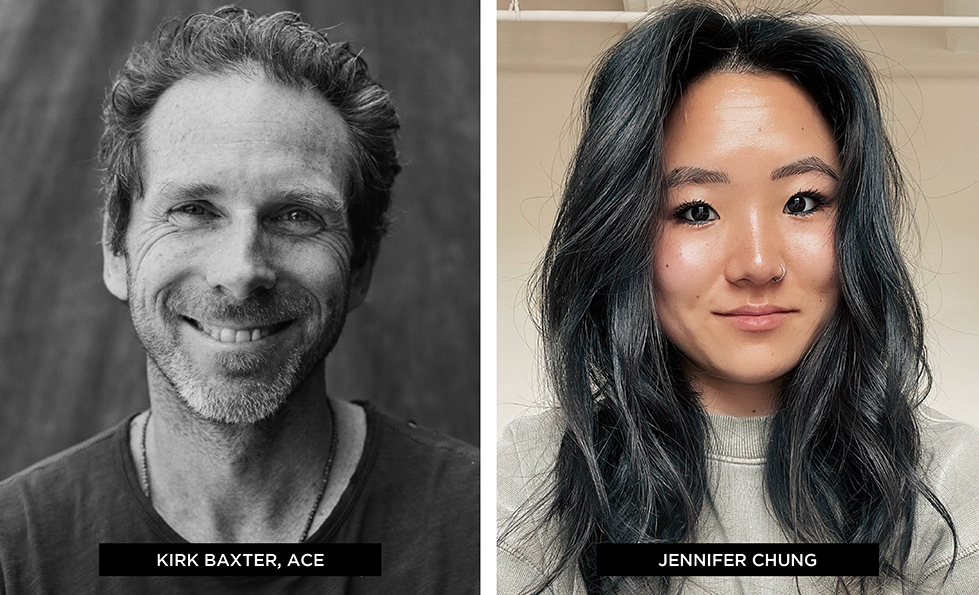
Isabel Sadurni speaks with editor Kirk Baxter, ACE, and his assistant, Jennifer Chung, about their work on A House of Dynamite

Kirk Baxter, ACE, is the rare craftsman whose speed in editing feature films feels like a refinement of taste, his Australian dry humor buffering the seriousness, precision, and work ethic that turns narrative chaos into clarity. Splitting his time between New York and Los Angeles, Baxter recently spent six months in a Tribeca loft shaping A House of Dynamite, a political thriller, directed by Kathryn Bigelow, about a rogue missile on a straight-line collision course with the United States. A film about a rogue missile on a clear path to the United States lands with particular gravity at a moment when superpowers Russia and the United States have chosen not to renew the START treaty, first signed in 1991, leaving the world, for the first time in decades, without the most basic limits on nuclear arsenals.

Best known for his collaborations with David Fincher, work that earned him two Academy Awards (shared with Angus Wall, ACE) for The Social Network and The Girl with the Dragon Tattoo, Baxter seemed a natural fit to director Bigelow, for a film built around the 19 compressed minutes before impact and annihilation. Yet the project posed its own editorial puzzles: a Rashomon structure composed by screenwriter Noah Oppenheim, a documentary-style shoot, and as many as 15 cameras rolling at once.

When we met in January 2026 via Zoom, Baxter was already deep into his next Fincher project, with the practiced calm of someone accustomed to living inside multiple timelines at once. Joined by his longtime assistant editor, Jennifer Chung, they walked me through the creative decisions and practical strategies that gave the film its relentless focus and momentum.

Isabel Sadurni: How did the choice to edit in Tribeca come about?

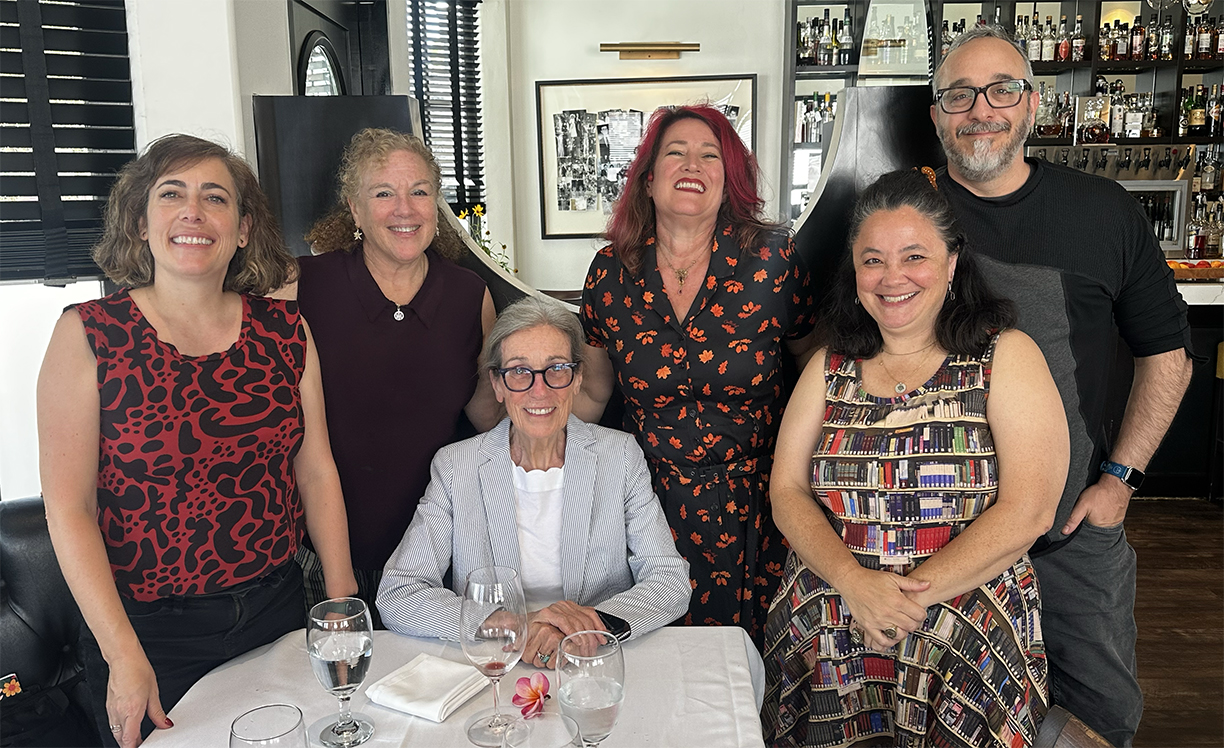
Kirk Baxter, ACE: Kathryn (Bigelow, director of A House of Dynamite) lives in New York, so it was much easier for her. I was in the process of moving to New York and it seemed like a wonderful way to start to tilt more in the New York direction. I was in an apartment in Tribeca that was two blocks from where Kathryn lived, and we set up a cutting room one block from me. We held screenings one block from the cutting room. We were mixing five blocks from the cutting room. We ate in all those restaurants. Tribeca became our little sort of college town for filmmaking. It was that perfect idyllic way of New York living, where everything’s at your fingertips. I adored it.
IS: You mentioned mixing in Tribeca as well.

KB: Right, Kathryn has worked with Paul Ottosson for a long time and she flew him in to do it. I think he did a lot of work from home to get himself ready. Then when he needed and wanted all of us chiming in, that was all taking place in New York. Paul now has an apartment in Philadelphia, so Paul, who is a terrific sound designer and mixer, is now out here on the East coast.

IS: Did it impact the edit in any other way other than the convenience, the camaraderie – was there some way that the New York vibe ingested itself into the process?

KB: Being in Kathryn’s neighborhood, it just felt easy. It’s a challenging movie in that it’s challenging its audience, but there was a simplicity to crafting it, with Kathryn having the ability to sort of come and go. I started when she finished filming. The space that we took was a loft which the post team turned into an edit facility. She was in the office next door, so we were always together. I guess I viewed it as, we were like a group of pirates in this little cubby house that we set up.

IS: I’ve always wanted to be a pirate.

KB: We had the option of being in a more corporate facility with a mixing place, a screening room – a very traditional, conventional space. And, I was like, “Nah, let’s do the busted version where we put it all together ourselves.” It just felt more like independent filmmaking, more communal.

Jennifer Chung: Because we were in an open loft, I feel like it really helped us as a team to work together instead of being isolated in individual offices with our doors closed or whatever.

IS: That collective creative energy starts to generate a kind of hive mentality where everyone is in sync which is powerful. How long was the edit?

KB: I think I started in December and it was wrapped up in June. So, like, six months.

It was fairly rapid. So much of that goes toward getting to cut into story order because I wasn’t editing as they were shooting. It’s such a luxury to get to cut something in story order.

IS: Was that Kathryn’s preference?

KB: No, it was my preference because it was such a complicated movie. It’s cleanly chopped into three parts, so we did one chapter at a time and then we’d pass it on to Paul and say, “Hey, can you start doing your sound on this.” then we’d start working on the next chapter. And, same thing, we’d pass it to visual effects.  …And it was really working for us. Visual effects was trying to put the squeeze on me to jump forward to the ending so that they could get some of the shots started. And I was like, “No, no, no, no, no, no. We’re going through story order.”

IS: I think it’s safe to call this a Rashomon-style structure – three different perspectives on the same 19 minutes. And you’re working with director Kathryn Bigelow and screenwriter and producer, Noah Oppenheim who are both known for their devotion to authenticity. Then you add the editorial challenge of layering different voices, different characters, and scenes we’ve seen in previous chapters, that must be revealed later in a new way. How did you set yourself up to execute that? What was your method for keeping the structure clear while still letting the story unfold in a surprising way?

KB: Well, the practical part of setting myself up for that is Jennifer Chung (Assistant Editor).

Take it away.

JC: Because it was a lot of repeating actions and lines, it was a challenge to organize. And because it was shot like a documentary, there’s a lot of B roll. For instance, when you’re in Chapter Two in StratCom, they were shooting a lot of the people that are on the conference calls live. We had multicam shots that were sometimes up to 15 or 20 cameras per shot, which adds up to a lot of footage to sift through and select from. It was definitely challenging to sync all of that and get that prepped and organized in a way that was efficient and helpful for Kirk.

KB: I think from the beginning, in terms of the written script, if I’m in Scene One, I asked Jennifer to get me everything in Scene One that I could potentially cut to, no matter what it was designed for. Because you can be in multiple places and offer multiple perspectives on the same bits of dialogue.

Then, as they were organizing it, I was cutting it and their job was just trying to stay in front of me. We swept through the whole movie that way. Then when we got to the end, I had to backtrack and go, “OK, I used this piece of dialogue for the President, but now that I’ve cut his performance on screen, I want to use that same on-screen audio performance elsewhere, so I need to go back and swap that in for the one that I chose earlier.” So there was a lot of sort of wriggling back and forth between how do we make these things feel like a repetition that remains accurate to the pieces of dialogue and information, but also remain accurate in the time that they take to unwind. So, there was a little bit of, “If I make it accurate, it kind of breaks Reel One but I’m making Reel Three better. So what if I kept Reel One the same, but change Reel Three . . .” It was a lot of that.

And, at the same time, that work is secondary to Kathryn’s emphasis on the authenticity and the performances and the feeling. We did more of that than was on the page because we had the ability to do it, based on how Kathryn filmed it. Once we had that cake baked, then I had to do all of my editor neurosis stuff of perfecting the use of repetition. For me, I got sort of a joy from being able to grab all these little footholds to keep track of where you are, and in knowing the mathematics of it all.
IS: When you were working through this, were there other discoveries that unexpectedly surfaced?

KB: The blueprint of the screenplay gives everybody this thing to work from and it was a wonderful screenplay. I mean, I read it and I was like, “I’m in!”  But naturally, the best laid plans always need a little bit of shimmering, to, sort of, get them into place. And Kathryn gives a lot of freedom to the actors. As long as what they’re doing falls within the idea of the main plan, and they’re still sort of saying the script, then they can present it their own way. That allowed the actors to deviate and the edit to deviate.

For instance, there was some impromptu stuff that we kept, like the officer’s phone call to his mother, saying, “No, I’m fine, I’m fine.” That was all impromptu. It wasn’t on the page. That was a discovery in production, that just got stretched into a really powerful moment.

There was another whole thing in the helicopter at the end with the President, where the person says, “Your choices are surrender or suicide.” That whole scene, with the President saying, “I need a minute.” It was never designed to be on screen. It was only designed to be in Chapter Two and just to hear the President’s voice.

But Kathryn, thankfully, didn’t want to just record him in the car at the end of the day. She filmed him doing it where he would have naturally been in the timeline. So we had the ability to use it. And it created more pressure in the last chapter to include it.

There was lots of stuff like that. And the repetition of “hitting a bullet with a bullet” – key lines where instead of just experiencing them once, I used repetition to clue us in. So, the edit wriggled around, but we were always singing to the tune that was written.

IS: Jennifer, I’d love to get more of your insights. What were some of the challenges unique to this project that you had to grapple with as the AE?

JC: We described the organization of the footage and trying to stay ahead of Kirk because he works so quickly. Sometimes, there were pieces from Chapter Two or Chapter Three that he needed to work with in Chapter One, which meant that we had to gather and start prepping those. There were also many times where we would have to go through and check the accuracy of things, like, “Did he say this line in Chapter One?” versus Chapter Two or Three.

KB: I relied on all the assistants to make sure that I was being accurate with the dialogue that’s being used in each chapter, that it’s the same performance, that I haven’t strayed. And there were loads of little pieces that you guys captured.

JC:  Yeah, it was definitely a scavenger hunt. The other tough thing was that we also had to be sure to match what the background actors were saying in each scene. And to be sure that what time something was happening was accurate. There were many instances, when it was like, does that timeline match in Chapter Two or Chapter Three? There was a lot of checking back and forth.

KB: You guys had a book, like a Bible.

JC: Oh, yeah – there were many Google spreadsheets tracking all of this information and data and, of course, tracking what was changing where, so that it was consistent between chapters.

KB: And because this had been prepped and done so well, I was able to just follow performance, follow what I’m interested in, follow the drama, you know, just trying to wring out every drop and exploit it. The side of my brain that’s used for trying to find things, I didn’t really have to utilize too much because it was made very simple for me.

IS: Can you talk about the interaction with Kathryn and how things evolved from your conversations?

KB: Kathryn was having a blast. Kathryn’s a fan of the actors. She’s a fan of Barry, the cinematographer. She’s a fan of Paul, the sound mixer. …And she’s sort of painting with all these people.

So she was really enthusiastic as I was building it. She was so excited to share with me the next scene that I’d yet to see and experience. And she was constantly trying to steep me in the kind of real-world perils of what was as stake. Like every other day, I’d wake up, and there would be a text from her, with some Guardian article about how many nuclear … or just some awful news and information that you just don’t want to know about but that makes the film that much more authentic. Kathryn was constantly sharing this stuff. Kathryn was busy making a political statement, masquerading as a thriller. She had a very clear idea of what the destination was.

Episode 10: The Making of Cover-Up

Isabel Sadurni speaks with editors Amy Foote, ACE, and Peter Bowman, and director Laura Poitras about their documentary Cover-Up

In Cover-Up, from directors Laura Poitras and Mark Obenhaus and out on Netflix on December 26th, editors Amy Foote, ACE, and Peter Bowman along with director Laura Poitras took on the formidable task of shaping Pulitzer-Prize winning investigative journalist Seymour Hersh’s 50-year combustible archive of writing into a single cinematic portrait. What emerges is not only the portrait of a journalist, but the larger story of an American cycle of government-initiated atrocities answered with impunity, and the impunity that breeds more violence until, at last, one insistent voice, Hersh’s, reminds us that history is not an inevitability but a choice. And that we, as viewers, are invited to bear witness and offer our own testimony in response to what we see and learn. I spoke with the filmmakers about the past-future language they created for the film, the Pakula-esque play of scenes, the resonance of archival images, and the tricky art of pacing a political thriller.

Isabel Sadurni: Seymour Hersh has been recognized with a Pulitzer Prize and has broken several stories that have come to define American political culture. He’s written 11 books and continues to be active in confronting deception and impunity in American government and the political sphere. Can you talk about guidelines you set up for yourselves to give structure and contour to such as massive undertaking?

Laura Poitras: It was definitely a daunting film to assemble into a single feature.
I’d been trying to convince Sy to do a film for 20 years. Hopefully the film answers the why question. There’s a 50 year timeline to cover. His body of work is extraordinary.

Amy and I had just finished All the Beauty and the Bloodshed about Nan Goldin. And there were some lessons in that film that we carried forward in terms of approaching this project. Both films cover half a century of history.
From the very beginning Cover-Up was always a portrait of Sy, and a portrait of the United States. We knew that the film would live and die on the archival that could make the past tell his story in present tense. We asked ourselves what did we have of Sy’s contemporaneous reporting that could bring the audience into the moment of when the story’s being broken.

For example, there’s a point where we time-travel from My Lai to Gaza. It’s very intentional, as if to say to the audience, this story is not a history that’s fixed. Or how can history be presented as not inevitable? History is created through choices. And this film was trying to make connections across time – My Lai, Vietnam, Iraq, Gaza. Those are some general ideas of what we were aiming for.

Peter Bowman: To Laura’s point about history not being inevitable. We knew that there was a lot of resonance between some of the bigger stories in Sy’s body of work, like My Lai or Abu Ghraib, but that the film was going to be about more than just Sy as a person. Laura had a huge board with a scene card for each one of Sy’s stories.

Amy Foote, ACE: There was so much research that was done by our producers, Olivia and Nora. We built as many of Sy’s stories as we could to see what archival we had to support it. Many people who come to the film already know Sy’s big stories that he’s famous for, but a lot of people don’t. One of our challenges was how do we engage both of those audiences? We discovered that Sy’s investigations would be the engine, and it was important that we never got  ahead of the story or ahead of Sy piecing together the story so that when Sy’s discovering something new, we’re discovering it alongside him. Even if you came in knowing one of his big stories, experiencing it broken down into a series of steps led by Sy in the moment, felt engaging and new. Once we had an assembly, we started to see themes emerge about power, about American impunity, state violence, cover-ups, lies and failures of the press and we considered which of the stories could speak to each other thematically. We also considered which ones tell us something about Sy’s character or his development as a journalist and lastly, which stories could shed light on the moment we’re living in now.


LP: There were some stories that didn’t make it in the film because they didn’t serve the larger story about atrocities and cycles of impunity and cover-ups and Sy’s exposing of these events.  At one point, we did have chapter titles until the chapters dropped away. I was probably the last hold out for the chapters, but they were useful to keep it thematic, so that we didn’t feel tied to chronology. There are chronological stretches but then chronology starts to collapse as the film progresses.

I definitely felt a breakthrough in the edit when we found the chemical biological warfare opening as a prologue. It’s this two minutes where you’re dropped into deep water. And we have our protagonist calling out the government for lying. For me, once that was in place, the audience could see this was the kind of story that was going to be repeated many times.

Then we started building. We knew that there were pillars. My Lai was going to be a pillar. Obviously, Abu Ghraib torture was going to be a pillar. When we started filming there was no genocide in Gaza. We had no idea that would be part of the film. That happened in the course of filming .

IS: Can you tell us a little bit about what the back and forth was like between editorial and production?

LP: Yes, we were shooting at the same time as we were cutting because we knew that one would inform the other. Peter and Amy would send us notes. We would interview Sy for two days then come back to cut. He’s not a linear storyteller. By the end we had roughly 40 interviews with Sy, or roughly 120 hours.
IS: Going deeper into the scene building in the edit. How did you divide and conquer the mountain of scenework you described?

AF: We all, to some degree, touched everything in the film but for the most part, each of us had ownership over certain sections.

LP: For instance, Amy was the lead on My Lai. Peter was the lead on Kissinger and the New York Times.

AF: Laura took the lead on the Gaza reporting scenes. We passed stuff back and forth all the time. It’s nice to work with multiple editors because you have that shared brain, and different skills and sensibilities.

PB: Some directors never set foot in an editing bay, so to have Laura fully there was such a privilege. You can get a better sense of what directors are interested in by how they cut something. And if I was banging my head against something for a week, I could take it over to Amy and ask, “What do you think of this?”

AF: We all were in the same room together. We would work individually and then we’d come together to screen each other’s scenes.

LP: We worked from a shared server on an Avid system. Our archival producer/full producer, Olivia Streisand, was on the project for two years from the beginning and was constantly finding new material. There’s over 6,000 archival elements gathered for the film. It was a very complex organization of the material. Every theme had a string out that was chronological and also cross referenced into every character.

We were always on the lookout for archival that could play like narrative drama. For instance, in the scene where Sy debates the head of the CIA, William Colby . . .  it’s this beautiful scene, shot in 16 millimeter, where you have the protagonist and the antagonist going at it. We always knew that we were building towards that as being a big standoff. Then there’s this amazing scene of Lyndon Johnson talking about the war that says so much about the arrogance of the United States and presidents lying through their teeth. It was beautiful and we hadn’t seen it iterated millions of times in every film about the Vietnam War.

I had a strong sense of, if it was archival, if it was 16 millimeter, let the shot play. And the cinematographers were so amazing in the ‘60s and ‘70s. They would hold shots. They would give you beautiful establishing shots or reaction shots. It was a joy to work with the archival.
This was all organized in an Airtable, so when we needed to see something, we could go back in to find it. And the reason we’re three is because it would have taken a lot longer to edit if we weren’t three. As a director, I didn’t feel like it was fair to leave it all to … I had to edit because it was just a big question of “How is this going to be one film?”

IS: What was the timeline from developing the scene cards to delivery?

AF: It was probably just shy of a year and a half of editing. When I came on, Laura had done some test interviews with Sy. The archival team had been researching a little less than a year before that. Peter and I started looking at the archive as they were first starting the interviews.

IS: In the film you gave us this powerful punch of emotion but also gave us plenty of space to respond. Can you talk about how you set a pace and tone for this film as a political thriller knowing that things have to keep moving?

AF: I think there are two parts to this: first, the pacing and the language of the film and then, secondly the consideration of what we have to take in as viewers and creating space for that.

We had learned a lot from All the Beauty and the Bloodshed, not to push in on images and to trust silence.
When I started editing, I remember I’d feel an impulse inside me saying, “Okay, this is the time to cut.” But I challenged myself not to cut and to instead, see how much more I could hold on something and slow something down and play with the rhythms in order to do something that felt fresh and new to me.

LP: We were filming primary documents on a light table. And we really treated them with extreme respect, as if they speak back, as if they tell a story. I’m thinking of when Sy first sees a story about Calley in the newspaper … we loved showing the full context where you see the ads, and then punch into that little story that Sy saw. There’s something really interesting about telling a story about history through the ads without leaning into a kitsch vocabulary.

We were definitely referencing paranoia thriller films in the edit room. Alan Pakula would be the the main reference, All the President’s Men and Parallax View. That sense of something sinister that’s hidden and you don’t know where it is but it’s dangerous.

A lot of Sy’s stories included images of atrocities. We knew that we needed to establish that there’s a reason why we’re seeing these images, and then back off because we don’t want to linger. We wanted to provide an emotional space to give the audience the capacity to see the images but not use them more than we needed to. Also, with the Abu Ghraib torture images, we knew they had to be represented but we didn’t want to stay on them any longer than we needed to for the film. Then the spaciousness … time sometimes moves fast in the film, like it’s contracted and sometimes it expands. We didn’t want a passive viewing experience but how can we activate the audience to engage with the screen and not just lean back?

PB: On the one hand the pacing is a stylistic preference. There’s  an intensity of focus and a spareness that prioritizes the archival. On the other hand, the cumulative effect of having a lot of these encounters with archival as artifacts, in some ways, is that they act like mirrors of the larger themes of the film. Toward the end of the film, when Laura asks Sy, “What would have happened if there hadn’t been photographs?” and he says, “No story.”  I think there’s a cumulative ethical effect in the way that the archival is paced that activates the viewer to think about this stuff as evidence, and as witness and as testimony and not just as historical imagery accompanying someone’s life.

IS: As we’re talking, I recognize the questions that you were asking yourselves of how to achieve an active engagement from the audience speaks directly to the objectives Sy pursued in his writing, asking his readers to engage in confronting the atrocities of the world. And your emphasizing that history is not inevitable, but rather that choices, reactions can change the course of history is an invitation to the viewer to take action. Thank you for that.

I guess my last question is about sound design. Your layering of archival, interview and the musical score, was so effective in setting a mood and tone. Could you talk about how you worked with sound to support the themes of the film?

LP: Peter did an enormous amount of work on sound design, layering and cutting temp music that inspired Maya [Shenfeld] our composer.  Amy and Peter had worked together on Girls State, so Amy knew that Peter had a lot of skills in working with music and soundscape.

PB: Since we knew that we wanted archival to dictate the scenes, a lot of the sound work in the edit was to draw out things that were already there in the archival, to create a sonic environment and to invite the viewer deeper into it versus say a film with a montage where the music is in control. For example, when we first go to the Pentagon, we built in echoes and reverbs and hums so that you feel like you’re walking down that corridor in the Pentagon, and inhabiting the archival, rather than, “Oh, I’m watching the Pentagon.” We were also trying to emphasize the materiality of the archival sonically. So, sometimes the archive clip came in with static or tape sounds that would typically be discarded. In the scene when we meet Angleton when they’re spying on the protesters, we kept in some of the tape flap and static of that archival footage because the scene’s about surveillance.

We were not just cutting in space, but often in time. I’m thinking of when we go back in time to the Iraq War and Sy’s typing on his laptop and we start hearing this helicopter sound, which is the sync sound of the helicopter footage that takes us into the next section. We layered in a little bit of helicopter-esque sounds that play like music there to add a sense of dread, ominousness, spaciousness, foreboding and mystery.

LP: I could add that a lot of us came to this with appreciation for experimental or avant-guard traditions of both filmmaking and music. I’m thinking of Bruce Conner and Ernie Gehr. A lot of the temp music that Peter brought in came from that world. By the time Maya Shenfeld, our composer, came in, she had a pretty solid soundscape to work with and understood what we were interested in. She’s classically trained but works with synth and does a lot of improvisational takes. For this film, she did a lot of reel-to-reel because we wanted an analog quality to the score. Maya built a sound toolbox based on what we had established. Peter, as the music editor, worked closely with Maya on that. We wanted something that was retro and future at the same time. There were also times where we wanted to help the audience recognize that Sy’s a writer, to strip out sound so that people are being asked to read, particularly in the My Lai story. Then there are certain sections that have a heavier use of music. In the mix, I wanted to feel this sound. I didn’t want to hear it. As if it’s happening in your body more than you’re registering it in your ear, or there’s a heartbeat or you’re feeling the film’s presence.


Hamptons International Film Festival 2025

Written by Derek McCants, ACE | Film Festival Liaison, East Coast | American Cinema Editors

American Cinema Editors (ACE) continued to expand involvement with East Coast Film Festivals with a public event at the 33rd Hamptons International Film Festival (HIFF). Alongside the many U.S. and World Premieres at this year’s festival, ACE presented a “Morning Talk” entitled “Making the Cut: Editing as Storytelling.”

This panel of Editors, who all had films in the festival, included Brian A. Kates, ACE (Kiss of the Spider Woman), Nyneve Laura Minnear, ACE (Pretty Dirty: The Life and Times of Marilyn Minter), Hanna Park (On The End), Ferne Pearlstein (Ask E. Jean), and was Moderated by Sabine Hoffman, ACE.

During this wide-ranging discussion of the craft of Editing, the panel shared the “inside story” on the post-production of a feature film, including how to find the story in an unscripted documentary, creating the “in between” moments in a scene, the use of stems to effectively score a moment, the importance of the Editor’s early engagement with the Director, and how multiple editors can work on the same film.

In the Q&A that followed, conversation with the audience focused on how to find the pacing of a film, the importance of world building, and the benefits of what can be learned from test screenings.

Thanks to Joseph Krings,  ACE, Co-Chair, ACE New York Committee for his assistance in putting this event together!

View photos of the panel HERE
See photo caption info for photo credits.

Episode 9: Editor Pat McMahon, ACE, and The Last Twins

Isabel Sadurni speaks with Pat McMahon the editor of the documentary The Last Twins

What follows is the first in a series of conversations about films and the filmmakers behind them, who have aimed for something more than entertainment or even catharsis. These are works that see cinema not merely as spectacle, but as spark. I’m speaking of movies like Costa-Gavras’ Z (1969), Pontecorvo’s The Battle of Algiers (1966), Spike Lee’s Do the Right Thing (1989), Eisenstein’s Strike (1925), Barbara Kopple’s Harlan County, U.S.A. (1976), Martin Ritt’s Norma Rae (1979), the Dardenne Brothers’ La Promesse (1996), films in which ordinary people, usually at great personal risk and under unbearable conditions, find themselves enacting the extraordinary. What unites these works is not just a sense of political urgency, but a moral imagination: the belief that one person or a small group of people can change not only the lives around them, but the generations that follow. My intention is to remind us of how film, in its quietest moments or its loudest apexes, can move an audience not just to tears but to action, and that storytelling is the architecture of empathy, and one of the most potent tools we have for meaningful change.

The first is a conversation with New York-based editor Patrick McMahon, ACE, about his recent documentary The Last Twins (2025), a deeply human and unexpectedly uplifting chronicle, via firsthand testimony of seven Holocaust survivors, who as children were caught in the calculus of Josef Mengele’s medical experiments at Auschwitz, woven together with the quietly heroic story of Erno “Zvi” Spiegel, the Jewish prisoner whose acts of defiance and decency helped save their lives. I spoke with Pat from his home studio via Zoom.

Isabel Sadurni: Your career spans more than half a century, with work primarily anchored in tonally dark, scripted features, some of them iconic, The Stepford Wives and A Nightmare on Elm Street among them. Your most recent film, The Last Twins, a feature-length documentary on which you served as both editor and writer, offers an ending that’s, almost unexpectedly, uplifting. Unexpected, only because we anticipate the gravity of a Holocaust documentary. And yet, what unfolds is something more layered, more surprising. Were you aware of the multiple levels on which the film could potentially engage an audience from the beginning? 

Patrick McMahon, ACE: Yes. We were very aware of that and hopeful that it would work.

IS: What set you up to begin working on documentaries?

PM: In 2005, I was working in L.A. on the series Masters of Horror when my friend, Jon Alpert, called me from Iraq. Jon told me he’d been filming a documentary in the Green Zone of Baghdad for HBO, that he’s seeing stuff he’s never seen before and that he just filmed a 19-year-old Marine who came in talking and then died on the table in front of him. He talked to me for half an hour and was, understandably, very emotional.  

When Jon came back to New York, he and his co-director, Matt O’Neill, had 300 hours of footage and didn’t even know where to start. Jon asked me if I could come east from Los Angeles and help him cut a 20-minute clip to show to Sheila Nevins, who was then overseeing documentaries at HBO. I said to Jon, “I can give you two weeks because I’m between episodes of Masters of Horror.” They gave me 20 hours of material to work with and after two weeks of editing, we screened a 22-minute clip with Sheila. It was so successful that when we finished, everybody in the room was crying. Sheila insisted that I stay on the project, and I worked with Jon and Matt in New York for six months until we finished the film.

Sheila saw right away that that documentary was a surprisingly patriotic anti-war film. There was no way you could argue against it. We were showing these doctors and nurses in their military uniforms, performing surgery and saving people and being heroic, while also showing that war is hell. But we didn’t have to say that, we just showed it. That was my first documentary. It was called Baghdad ER. It won several Emmys and was very well received. It taught me that a film about a difficult subject can work on a few different levels, some of them unexpected.

For Baghdad ER, I had to learn how to take raw cinéma vérité footage and make it feel like part of a movie, rather than an interview or a news piece. Figuring that out was a turning point in my career which in turn, opened up opportunities to edit and shape documentaries addressing subjects that are important to me. 

Coming full circle, Jon Alpert’s co-director, Matt O’Neill, is one of the two producer-directors of The Last Twins, along with Perri Peltz. So when The Last Twins was coming together, Matt said to Perri, “Let’s bring Pat into this.” That’s how I landed with this project.

IS: Nice family connection.

PM: We trusted each other. I mean, we didn’t know where the film was going yet. But we trusted that we would find it together.

IS: Right, when it’s a documentary, you’re writing it in the edit.

PM: Yeah. I thought, if we can create a story with a three-act structure and let it play like a scripted film where people are wondering what’s going to happen next, and get the audience leaning forward, it’ll work. So that’s how we built it. 

IS: I’m assuming that’s why you have a writing credit.

PM: Well, the reason I have the writing credit is because, as we were putting this together, there were gaps in the narrative. 

I’d done a lot of research, reading both David Marwell’s book on Mengele and a 250-page college dissertation on Erno “Zvi” Spiegel. I also watched several other Holocaust documentaries. So when it came time to connect what the subjects were saying with the next part of the story, I wrote some voiceover on a legal pad, recorded it into my phone, and laid it into the sequence. We didn’t originally want narration, but as I was putting it together, we realized we needed it. Then, of course, Liev Schreiber replaced my voice.

Since I had written all the narration, the directors very fairly, but also very generously, said, “We’re going to give you a single card writing credit.” I’m very grateful for that.

IS: Talk more about the collaboration with the directors. Did you map everything out together?

PM: We talked about it a lot. I suggested the three-act structure to them very early on. We also had a two-hour meeting with our producer, Judith Richter, the daughter of our main subject, Erno “Zvi” Spiegel, before we started. We were very conscious not to tell the story ourselves. We wanted the men to take the audience through their experience with their own words. We created a tribe, which they in fact became at Auschwitz, so you would get the sense that not only are they going through this together, but you – the audience – are going through it with them. That’s why there’s a lot of repetition early in the film where two or three men describe the same thing, backing each other up. I found that to be very effective.

IS: The hero, Erno “Zvi” Spiegel, gave comfort to a group of about 50 to 60 children that he supervised. This was no small challenge considering there were bodies stacked like cordwood a hundred yards away. And though the boys were supposed to acknowledge fellow prisoners by their numbers only, he made the boys call each other by their names. He made them share food, whenever they got it by some miracle. He taught them in a kind of makeshift school and he did it all very quietly, confidently, and at great risk to himself. 

PM: This quiet heroism was the most appealing thing about putting the film together. We all agreed that what we wanted out of the film was something that would stir the audience emotionally rather than just relay a bunch of facts. It wasn’t until I was digging into those interviews that I realized that we might be able to pull this off.

We also, very consciously, decided not to put dead bodies in it. I think it’s really important that bodies are in films that serve as historical documents, but once you see that, you don’t see anything else. This is a story about people who made it through. We really wanted the audience to see these people not only as survivors, but as people who carry on. In the film you’re introduced to these 85- to 90-year-old men who share their stories. Almost all of them had not spoken about their experiences for decades, never even whispered about it, but when they got to see each other again, for the first time … I can’t watch it without crying.

IS: That’s a lot of emotional weight to carry into the editing room every day. I wonder if you might talk a bit about how you safeguarded your emotional center while working with such deeply affecting material.

PM: It was very difficult. Any editor will tell you that sometimes after hours, they’ll roll through the footage in their head, wondering what they might do next. 

During the making of this film, there were many, many times when my wife and I were out to dinner, with friends or engaged in some social activity when I would be staring off into space, and she’d say, “Pat, are you in Auschwitz?” And I’d say, “Yes, I am. I am. I’m sorry.” It was very difficult. I worked on it for a year plus, and I really did live with this experience, these men, and their firsthand stories every day. 

IS: How aware were you in working through this footage of World War II of the resonance of what’s going on in the world today?

PM: I was very aware of it. Antisemitism and hate for others is sadly, alive and well today. My wife, who recently passed away, was Jewish, as are my daughters. Halfway through the editing process for The Last Twins, my wife went into the attic and came across a letter dated February 1946, written to her grandmother from a 17-year-old cousin in Hungary who had recently come back from a concentration camp. The cousin described what happened to all of the family members when they were deported. It was very similar to everything that happened to the subjects in our movie. At the end of the letter, the cousin said they left Budapest on July 5, 1944, and arrived at Auschwitz on July 8, 1944. That meant that my wife’s relatives were on the same trains at the exact same time as the characters in our documentary. She didn’t know that when she brought me the letter and suddenly, The Last Twins, a story that I felt was important to tell, became extremely personal for me.

IS: The film has already been recognized with positive reviews. What have the reactions been like from the audiences?

PM: The world premiere was January 26th in Krakow, for the 80th anniversary of the liberation of Auschwitz. Some of the survivors were there at our hotel and at our screening. You want to talk about being fulfilled? 

A lot of people are surprised that it’s an upbeat story. It’s strange to say that about a Holocaust film, but it’s a story of survival and triumph. I think the response that makes me most happy is people coming out of the film grateful to have seen this story, whereas with some Holocaust films, it’s just too much. I think this is one where you can say, “I’m glad I saw that. I’m glad somebody acted that way. I would hope that I would act that way under those circumstances.” Those kinds of responses let me know that we’ve done our job.

IS: Where can people see the film?

PM: The film is releasing slowly around the country. It qualified for awards playing in New York and Los Angeles. It’ll be in Miami, Chicago and Boston. It’s making the rounds and it’s going to be part of a permanent collection at the United States Holocaust Museum. 

ACE at Tribeca Festival 2025

Derek McCants, ACE, shares the latest from the Tribeca Festival

ACE events at this year’s Tribeca Festival started on June 5, with a well-attended Editors Happy Hour at The Brooklyneer gastropub, sponsored by Extreme Music. Invitees included NY Metro area ACE members and editors who had work in the festival. This kickoff was a chance to have drinks and nibbles with peers and share common experiences.

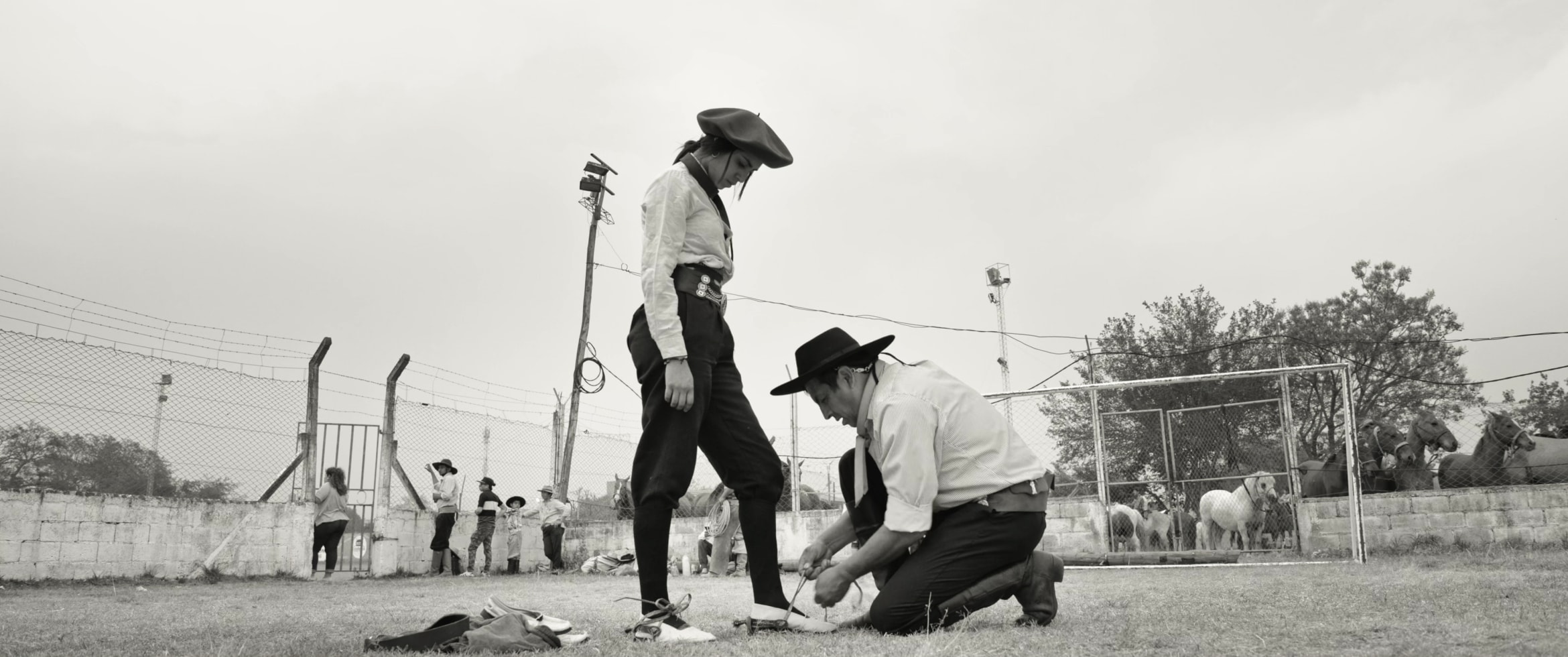
The Happy Hour was followed on June 9 by a sold-out panel held at the Festival Hub titled, “Editing Across Story Platforms,” which included ACE members who all had work in the festival – Andrew Morreale, ACE (Barbara Walters Tell Me Everything); Mollie Goldstein, ACE (Seasoned); and Stephanie Filo, ACE (Horsegirls); and moderated by Sabine Hoffman, ACE. Their insightful conversation spanned topics ranging from how early the editor should start on a project, to working with first time directors. The panel discussion was followed by a Q&A with a very engaged audience. Encouragingly, many of the questions concerned how to work best with an editor!

And, as the last event of the inaugural Tribeca Storytelling Summit, editor, director, author Barry Alexander Brown, ACE, presented a Masterclass, showing clips of his past work, including his latest film with Spike Lee, Highest 2 Lowest. He shared tales of working with Spike Lee, Mira Nair, Denzel Washington and Tony Kaye (who was in the audience). Barry also revealed his early experience of “imposter syndrome” doubtfulness, how to know when not to make an edit, and strongly encouraged taking the necessary time in the schedule for the edit.

This year, the festival was expansive, both in content and locations.  Events and screenings were held at The Tribeca Festival Hub at Spring Studios, Village East by Angelika, United Palace in Washington Heights, the Beacon Theatre on the Upper West Side, BMCC Tribeca Performing Arts Center, SVA Theater in Chelsea, and Carnegie Hall. The festival also included not just star-studded world premieres, but panels, masterclasses, seminars, immersive experiences, audiobooks, games, and musical performances.

Special thanks to our gracious partners at the Tribeca Festival – Faridah, Jeremie, Elaine, and Zachary. And, to the Extreme Music staff – Jared, Ellie, and Olivia, for their continuing support of NY area editors. 

You can see photos from the event HERE

ACE Connect Committee Luncheon with Harry Keramidas, ACE

Kate Sanford, ACE, recounts the recent luncheon for Harry Keramidas, ACE, May 2025

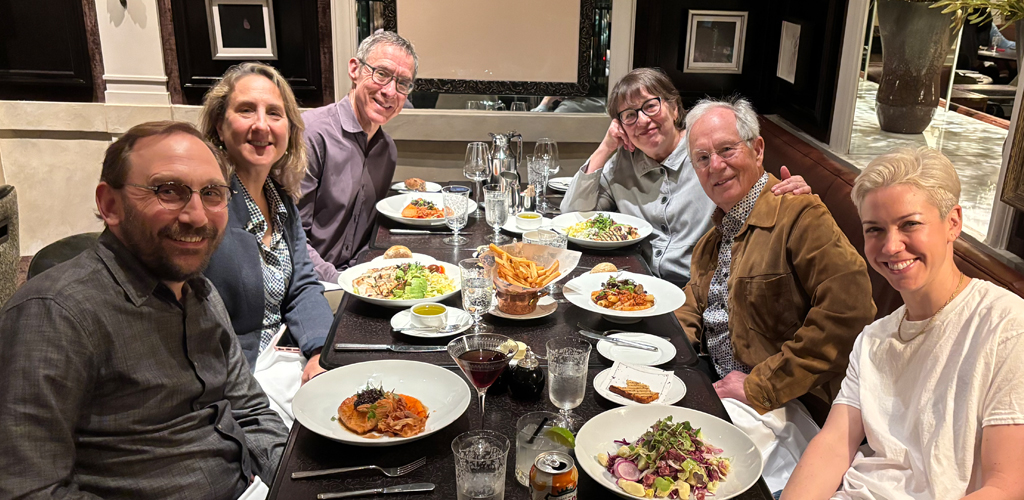
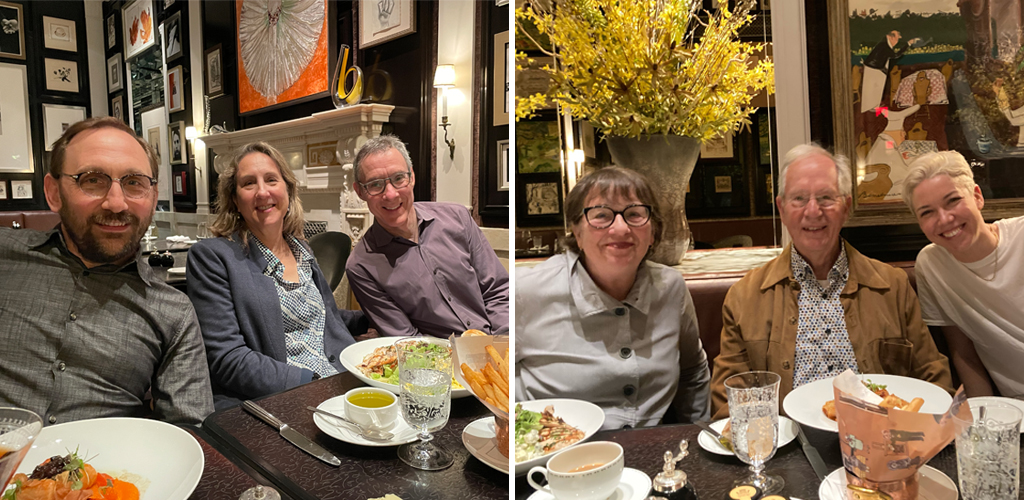
The ACE Connect Committee held the first-ever East Coast retiree luncheon for editor Harry Keramidas, ACE, on May 8th. Host members Erica Freed, ACE, and Kate Sanford, ACE, were joined by Harry’s wife, Renee, who happened to be celebrating her birthday, along with randomly selected ACE members Joseph Krings, ACE, and Simeon Hutner, ACE. Lunch was at the cozy and historic Dowling’s Restaurant at the Carlyle Hotel, where we enjoyed lively conversation surrounded by paintings and illustrations from their extensive collection.

Harry was very animated and open with the group, describing his early years: in the Peace Corps in the Dominican Republic, which sparked an interest in ethnographic films, and then as a mentee of Verna Fields while attending grad school at USC. He discovered his talent for filmmaking and editing while on the job, working as an editor for the Office of Economic Opportunity and others, editing more than 70 documentaries and educational films.

Harry transitioned to sound editor on New York, New York and then moved to picture, bypassing the rigid studio roster system. His career highlights include all three Back to the Future films, co-edited with his close friend and colleague Arthur Schmidt, Judge Dredd, About Last Night, Tales from the Crypt series and Contact. Harry recounted the historic decision to scrap months of work on the first Back to the Future movie and recast the lead with Michael J. Fox! His collaboration with Robert Zemeckis lasted several decades, and he describes the director as the sharpest he’s ever known.

Harry is enjoying retirement in Western Massachusetts. He started and now chairs the Ashfield FilmFest, which promotes short films made in or about the community. He also comes to the city for dinners and shows!

Thank you to Pacific Post for making these incredible luncheons possible.

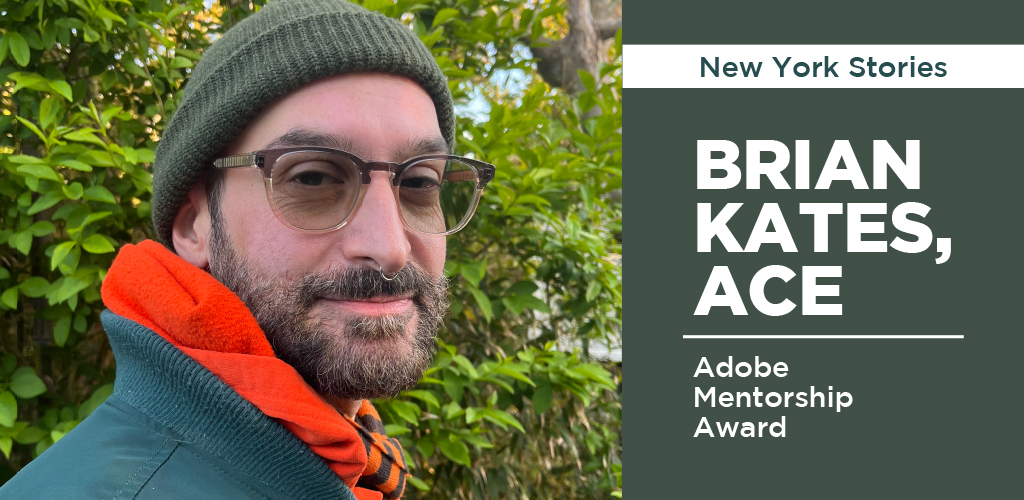
EPISODE 8: Brian A. Kates, ACE, Adobe Mentorship Award 2025

Isabel Sadurni interviews Brian A. Kates, ACE, 2025 Sundance Film Festival Adobe Mentorship Award Recipient

Every so often in a life in the arts—between outtakes jettisoned and scenes built in the dark of a picture editor’s den, there arrives a moment when the art of collaboration itself is celebrated. Such is the spirit behind the Adobe Mentorship Award, given annually at the Sundance Film Festival and shared between two editors whose generosity of insight and skills have shaped not only films, but fellow film editors. In 2025, the honor was shared by two such people: Vivien Hillgrove, doyenne of the Bay Area’s editorial scene, and Brian Kates, ACE, a New Yorker whose résumé (from Shortbus to Succession) is as artfully eclectic and popularly resonant as the films he’s helped bring into being. In this conversation, Kates reflects wryly, warmly, with the keen observations of someone used to shaping emotional moments, on what it means to be seen not only as a storyteller but as a mentor, not just a shaper of scenes and worlds, but a builder of people.

Isabel Sadurni: What was it like when you found out you were the recipient of 2025’s Adobe Mentorship Award?

Brian A. Kates, ACE: I was floored to get the news that they wanted to give me this award. I spent so much of my career being the youngest person in the edit room. Youth isn’t typically the characteristic one associates with mentorship, so I hadn’t thought of myself as a mentor at all until recently. 

But then I remembered moments like when I was editing Tamara Jenkins’ film Private Life seven years ago, and my brilliant and fearless assistant editor, Tricia Holmes, asked me one day, “How am I doing? Do you have any feedback for me?” I was startled because when I was an assistant, it never occurred to me to ask that question. I didn’t want to feel vulnerable or have someone bring up my mistakes.

Thanks to my husband, who’s an academic working in public health and manages many more people than I do, I started to understand, through his experiences, that there’s a way to communicate and grow relationships that makes people do their best creative work and feel entitled to be creative partners. I think over time, I’ve learned how to really listen. I’m learning. It’s a constant. 

The way the award works is that they put out a call to editors and assistants who nominate someone. Joseph Krings [ACE] nominated me. I’d been his mentor through Sundance when he won the Sally Menke Fellowship. Joe’s a great editor and community builder. His letter to Sundance about how much my guidance meant to him was very moving. It makes me grateful for the New York editing community, which is quite a tight-knit community.  We remember who helped us. I think the great thing about the New York editors is that we don’t generally feel that competitive, and we want people to succeed. 

It was also very moving to share an award with Vivien Hillgrove, who’s done incredible work in both fiction and non-fiction. Her contributions to the Bay Area editing community are legendary.

IS: Who were some of your most influential early mentors?

BK: One of them was Elena Simon, the Associate Dean of Student Affairs at NYU. Simon was and is a formidable presence and scholar. I considered her my art mother. The first day at film school, she sat us down and told us that our job as young artists would be “to engage with the world and not to escape from it.” I had just come out as queer and at the time, in the early 1990s, the culture war was real. Republican Senator Jesse Helms had recently proposed an amendment to a bill that would bar federal money being used for obscene and indecent art and he was specifically going after queer artists. The term “cultural elite” was being used as a slur, so Dean Simon passed around buttons for us to wear that read “cultural elite,” which I thought kind of made us look like assholes, but, looking back, I think they were meant to be taken ironically. 

When Todd Haynes’ first feature film, Poison, won the grand jury prize at Sundance four months later, some conservative activists attacked it because $25,000 of its $250,000 budget came from a National Endowment for the Arts grant and according to the American Family Association, it contained explicit sex scenes of homosexuals involved in anal sex. Dean Simon’s encouragement to live in the real world moved me toward, not away from, these issues as artists.

While at NYU, I also interned at MIX NYC, the queer experimental film festival. That’s where I first met Jim Lyons, Christine Vachon, and Todd Haynes, whose work and mentorship profoundly shaped me. Jim was Todd’s editor and also starred in Poison.  Jim hired me on Safe, my first professional editing job. He didn’t teach me the technicals; that came from his assistant, Sakae Ishikawa. But Jim gave me something more valuable, which was an artistic worldview.

Jim was a Renaissance man, deeply influenced by music, visual art, film history,  philosophy, and held a commitment to the wider world of art and politics, all of which found a way into the edit suite. That worldview led me to a creative community that included John Cameron Mitchell, Dee Rees, George C. Wolfe, and Bill Condon. 

When it came time for Jim to hire the crew on the next film after Safe, I figured he would call me. I’d been jumping around between assistant jobs and editing low-budget films, and I was much more experienced. But he sat me down at a cafe in the West Village, and he told me that the only way to become a full-time editor was to be a full-time editor, and I couldn’t take any more assistant jobs. He made me cry. I didn’t understand it then, but the most important thing Jim did for me was to let me go.

IS: That’s powerful. How do you think your ideas on community, collaboration, and creative leadership have evolved since then?

BK: Well, in the editing room on the level of the films I’m working on, there are maybe 3-4 people. I’ve learned that good ideas can come from any source: from the studio giving their notes or from your editing room assistant. There’s no hierarchical value in people’s ideas. Obviously, the director is the filter through which the creative vision of the movie flows, but that doesn’t mean that it isn’t shaped by the impressions of many different people along the way.

IS: Now that you’re officially acknowledged as a mentor, what do you hope to pass on?

BK: I hope to encourage people to think expansively and globally. My sensibility is kind-of high/low. I mean, I love pop culture. I’m a child of Star Wars and Indiana Jones, and that’s still inside me, but when I went to NYU, I got into Pasolini and Kubrick. I love that we can be both carnival barkers and philosophers. I want to encourage younger editors to revel in their own taste and to understand that film can be fun, political, subversive, and poetic all at once. A friend of mine, a brilliant documentarian, once insisted to me that filmmaking isn’t activism, and it’s grandiose to think that it is. But that doesn’t mean it’s unimportant either.

IS: That’s a great reminder. Let’s talk about the non-profit that you chose as the co-recipient of your financial reward.

BK: Right, so as part of the award, we’re allowed to donate half the prize money to a nonprofit of our choice. I chose MIX NYC, the queer experimental film festival founded in 1987 by Sarah Schulman and Jim Hubbard. It’s the oldest queer experimental film festival in the U.S., and a fantastic cultural event. As I mentioned, it’s also where I was an intern while I was at NYU, and where I first met some of my mentors. One of the festival directors of MIX, Stephen Kent Jusick, used to run cine-salons at his apartment, which became an inspiration for the salons in John Cameron Mitchell’s Shortbus, a film I edited. And we premiered a rough cut of Jonathan Caouette’s Tarnation at MIX. So for me MIX’s influence on my life is deep.  

MIX was dormant during COVID. But the festival was revived by Alex Smith and Blake Pruitt. Blake was my assistant editor on several films. So by sharing the award with MIX, I’m also sharing it with one of my mentees and honoring a specific part of New York film history that resonates for a community. 

IS: Looking ahead, what are you working on now?

BK: Last year I edited Kiss of the Spider Woman, directed by Bill Condon, starring Diego Luna, Jennifer Lopez, and Tonatiuh. It’s coming out in October and will be distributed by Roadside Attractions. It’s one of the great Kander and Ebb musicals that was just screaming to be adapted into a film. It takes place during the Dirty War in Argentina in the 1980s, and like another great Kander and Ebb musical, Cabaret, deals with escapism and under authoritarianism. I worked with Bill Condon 15 years ago on the pilot of Showtime’s The Big C, and I was overjoyed that he asked me to work with him again.  

Right now, I’m working on a movie written and directed by Cathy Yan, who made Dead Pigs and Birds of Prey. We worked together on an episode of Succession Season 3. It’s an art-world satire starring Natalie Portman, Zach Galifianakis, Catherine Zeta-Jones, Charli XCX, Jenna Ortega, Da’vine Joy Randolph, and Sterling K. Brown. I’m working again with my additional editor, Matthew Buckley, who was on Kiss of the Spider Woman and Succession. So there’s a lot of continuity right now in my editing room.

If I’ve become a better mentor over the years, it’s because I’ve had great crews who have supported me, communicated brilliantly, and were true creative partners. In accepting this mentorship award, I tip my hat to my mentors, and I also tip my hat to them for changing what was broken about the workplace and showing me a better way. 

Lillian E. Benson, ACE, Receives the 2025 BPM Trailblazer Award

Derek McCants, ACE, attended this year’s PitchBLACK Awards where Black Public Media honored legendary editor Lillian E. Benson, ACE, with the Trailblazer Award. Headshot ©Wm Stetz. Event photos by Derek McCants, ACE

On May 1, Black Public Media (BPM) honored Lillian E. Benson, ACE, with the 2025 BPM Trailblazer Award at the 2025 PitchBLACK AWARDS, which were held at Harlem’s Apollo Stages at the Victoria.

The Awards were accompanied by a BPM Trailblazer Retrospective, with selected films from Lillian’s body of work available for screening. Included were Eyes on the Prize: The Keys to the Kingdom (1990), The Taste of Dirt (2003), Beyond the Steps: Alvin Ailey American Dance Theater (2006), and American Masters – Maya Angelou: And Still I Rise (2016).

Lillian was the first female editor of color inducted into American Cinema Editors (ACE), and has been honored with a Career Achievement Award from the group in 2022.

After taking the podium to a standing ovation, Lillian gave an eloquent speech, ending with a call to continually “plant seeds” and nurture others, especially in these times.

Then during the Director’s Chat with Brittany Luse that followed, Lillian spoke of her version of being “stubborn,” highlighting the importance of truth in her life and her work.

The Awards were preceded the day before by the PitchBLACK Forum, with included pitches from rising content creators of color during an Immersive Competition and a Film Competition. Winners of those competitions were announced the evening of the Awards. It was inspiring to see the work of these artists and to be present at this recognition of young Black excellence. To date, PitchBLACK has awarded $1.8M in production funding to Forum winners.

For information on the PBS broadcast of the PitchBLACK Awards coming this June, visit blackpublicmedia.org.

#BlackPublicMedia
#LillianBensonACE

Episode 7 (Apr 2025) – 2024 ACE New York Interns, Margot Maxwell and Kennisa Ragland Share Their Story

Isabel Sadurni interviews the 2024 ACE New York Interns Margot Maxwell and Kennisa Ragland.

Internships, as we’ve come to know them, often function less as beginnings than as an act of semi-formal genuflection—an eager, sometimes awkward bow before the altar of experience. They’re the modern equivalent of sweeping the master’s atelier, a rite performed more for proximity than participation. But ACE’s New York internship program, which made its debut in 2024, upends this inherited sequence with something closer to cultural baptism than bureaucratic onboarding.

Rather than running errands or getting coffee, interns are plunged—deliberately, and perhaps a bit bracingly—into a world of creative problem-solving, spontaneous collaboration, live debate, and, yes, abundant listening. There’s no hands-on technical work here; ACE-NY sensibly leaves the mechanics to the scaffold of training that frames the experience. What the program offers instead is a space—structured, yet filled with unpredictability, where interns are invited to wrestle with the essential anxieties and curiosities of creative editorial life. What exactly is the work playing out here? What do I actually know? Can I ask that question without sounding dumb?

In the company of some of the industry’s most highly respected and discerning editors, those questions were not just tolerated—they were woven into the fabric of a working rhythm that values the discovery of the most potent storytelling craft possible. I spoke, over Zoom, with Margot Maxwell and Kennisa Ragland, both recent participants in the 2024 ACE-New York cohort, about the moments of clarity—and confusion—that defined their time inside the program. What emerged was not a tale of prostrate apprenticeship, but something closer to a series of creative collisions, provocations, and occasional revelations.

About the program: Each year, the American Cinema Editors Internship Committee selects two interns from three cities—Los Angeles, New York and London—and provides them with the opportunity to shadow the editing rooms of a feature, a television show, and an unscripted show for one week each in addition to visiting several facilities integral to post-production. The ACE Internship Program is geared toward anyone with a passion for editing, who is just starting their career in post-production. Find out more about the application process here.

Isabel Sadurni: You interacted with several studios and editors. What made the interactions valuable to you personally?

Kennisa Ragland: During our facilities week, we went to A24 and got to listen in on conversations between post producers, post supervisors, and one studio person involving the decisions that go into what determines whether they acquire films before they’re produced, or in post, or whether they pick them up at the end. Hearing about their decision tree, beginning with looking through scripts and projecting what post will require based on how much VFX is involved or how many post producers or assistants they’ll need and if post can be done remotely or not gave me a better understanding of how a producer or post-producer might set-up post, and what the role of the post producer and post -supervisor is. All of that is so important for editors to understand because it affects how you can be the best possible team player. It felt like a real peek behind the curtain.

IS: Did they share sample timelines showing you when post enters the conversation?

KR: They showed us a timeline of the whole pipeline, which was great because it showed us all the points at which an editor interacts creatively.

Margot Maxwell: Film school students, without any real-world experience, might assume, “Oh, post necessarily and only comes later.” But after exposure to real-life projects, I see that post producers need to consider everything that may land with post before they enter a project. To be efficient, they need to evaluate the costs of doing something practically as opposed to trying to fix it in post before production begins. We saw how one phase impacts the other. 

We also talked to music editor Suzana Peric. I had no idea who she was when I walked in. She was so generous. She just kept showing us all this stuff. She showed us clips of films she had worked on, like Silence of the Lambs. She showed us a clip from the film with one piece of music and then showed us the same clip with a different piece of music. 

KR: It was the scene where Anthony Hopkins’ character is about to maul the officers when he’s in that big circular cage. Then she turned around and asked us, “What do you think? What do you hear?” It made me think about the edit and the music differently. Then she said, “OK, this is the one we ended up going with, and this is why.”  She said the song initially started when Jodie Foster’s character was walking in the airport and just played all the way through that scene. When they got closer to mix, they were like, “Something feels off. What do we do?” They decided to start the song later, so that it feels like it’s coming from his music box and not some non-diegetic sound. And that slight shift changed the storytelling. Hearing that kind of logic was very helpful. There were so many moments of pure inspiration and drive, like, “Oh my God, this is so cool!” We ended up being with her for three and a half hours. 

MM: The way that she asked those questions reinforced the fact that making a film is just all of us having creative opinions and building it bit by bit. We left her feeling really giddy. She taught me what music editing was.

We also shadowed Joe Krings [ACE], who brought us into his cutting room. When we visited his edit suite, I was a little nervous. I was like, oh, we should be flies on the wall and not bother him because it was his first week in the edit.

He talked through his process step by step and what he was thinking at each point. But he was so encouraging and asked us our opinion, and meant it. If he thought something was worth trying, then he’d be like,”Yeah, this actually works.” To me, that was an incredibly valuable moment.

IS: Now that you’re on the other side of the internship, what did you learn that’s been immediately applicable in the real world?

MM: It seems simple, but the practice of talking to people in this industry has been really valuable. We’re not in finance, we’re not in business, there’s no HR.  Learning that editors are, at a common level, film nerds. Being able to connect with them on that level and sometimes gain a friend or an ally. Learning that about the industry surprised me. 

KR: You’re meeting so many people. It became important to know how to just be a human being with them. I’m an introvert so it was something I was nervous about from the start, but the internship really helped me sharpen my people skills. 

We also got to see how assistants took initiative versus bringing other people into the conversation. I remember when we were in with Nick Houy’s [ACE] team. We met with his first assistant, who had worked with Nick quite a bit, so he knew when to take initiative and follow something through to the end. Versus other moments when he knew to say, “I need to talk to Stuart,” the post supervisor, or, “I need to go ask Nick because this is something a little bit bigger than just me.” It became clear that you have to consider the money and time being spent based on any decision, especially because they were doing reshoots.

MM: It was like learning the soft skills, like reading the room. That’s not something you can learn in a handbook. But you can’t know that until you’re in the room gauging, “Did she just have a bad call with the director or did the assistant just lose a file? So maybe don’t bring up something now. Or, is this an emergency? Like just knowing how to handle that. Picking up those skills was really important through this internship.

Nick was working on Jonah Hill’s new feature. It’s a funny one. We got to see one version of the movie and then a completely different version of the movie. So, two different two-hour versions, and we were like, “These are completely different films.”

IS: Did people talk to you about trusting your gut and trusting your instinct, not only in figuring out if a project is the right fit for you, but also when you’re making an edit choice, when you’re finding the rhythm of a story?

KR: We were on a doc with Adam Kurnitz [ACE], and he was really in the thick of it, so he couldn’t really talk as much. So we kind of just had to glean what we could. And I remember having an idea for a note, and I thought to myself, “Oh, I shouldn’t say it, I should just let it be and not bother him.” And then I think he did the thing that I had been thinking. And I said, “Oh, I was going to say that.” And he turned around and specifically looked me in the eye and and told me, “You should have said it. Like, if you felt it, you can say it, you should say it.”

IS: People go to movies and the theater and any storytelling environment, really, to feel emotions. I’ve always thought that editors are super sensitive creatures, and our antennae are what we use to focus the audience, right? It sounds like that scenario played out really beautifully with Adam.

KR: Yeah, literally everyone dropped some kind of knowledge, some kind of gem.

Applications for ACE, NY Internships open May 1, 2025. Find out more here

Episode 6 (Jan 2025) – The Diplomat

Isabel Sadurni interviews Picture Editors Gary Levy, ACE and Agnes Grandits, ACE; Re-Recording Mixer Dan Brennan; Sound Supervisor/Re-Recording Mixer Sean Garnhart; Music Editor Robert Cotnoir; Assistant Editors Tracy Nayer and Matt Nickelson. The Diplomat airs on Netflix

In Season 1 of Netflix’s dramatic television series The Diplomat, showrunner Debora Cahn (The West Wing, Homeland, and Fosse/Verdon) launched a seemingly fantastical storyline in which a U.S. diplomat is rerouted against her will to become a candidate as America’s vice-president in check against a manipulative operator dedicated to advancing their own interests in a corrupt administration which has tolerated or even orchestrated terrorism against its own citizens for political gain. Now in post for Season 3, Netflix’s hit political drama has been nominated for a PGA, DGA and WGA award.   Isabel Sadurni spoke with key members of the post editorial team about the evolution of their work and how the show continues to challenge and surprise them. Picture editors Gary Levy, ACE, and Agnes Grandits, ACE; re-recording mixer, Dan Brennan; sound supervisor/re-recording mixer Sean Garnhart; music editor Robert Cotnoir; and assistant editors Tracy Nayer and Matt Nickelson gathered via Zoom. Season 3 airs fall 2025.

______________

Isabel Sadurni: One crucial element in a show’s success is establishing a signature tone and rhythm. Can you talk a little bit about how the tone and rhythm of The Diplomat evolved over time?

Gary Levy, ACE: In the beginning of Season 1, we had this preconception that The Diplomat would play in a similar tone to Debora’s previous shows, like The West Wing.  We really pulled the first three or four episodes apart to stop what felt too close to re-playing that. There was a lot of work in Season 1 figuring out what the tone of the show really was.

Sean Garnhart (sound supervisor/re-recording mixer): Once we all figured it out, the tone remained consistent.

Isabel Sadurni: For me the dialogue is honest, provocative and completely absorbing.

Agnes Grandits, ACE: The writing is what guides us. The writing and the humor and, I mean, the actors are amazing.

Robert Cotnoir (music editor): One of the first things I said to Deb when I met her was that I love that the characters talk like people actually talk in real life, as opposed to a sort of two-dimensional, “There’s the bad guy, let’s go get him” kind-of dialogue.

Gary Levy, ACE: We discovered early in the editing of Season 1 that the heart of the show is Kate and Hal’s relationship. So even with this world of complicated politics going on, you don’t mind if things go by that you may or may not completely understand, because you’re so deeply anchored in the intimate, personal and complex relationships between the characters.

Robert Cotnoir: The music can also zoom in and out, meaning, we might build out a big music cue at the start, then zoom in to a quiet cue to support a more intimate exchange. So the score can be big and small at the same time.

Dan Brennan (re-recording mixer): Because it’s a political drama, any given episode may deal with international conflict, wars, battleships getting blown up et cetera, but then, in the same scene, we might zoom into a room of three people having a very private conversation off to the side, and the rest of the world falls away. When we do that with music, like Bobby was saying, we’re telling both pieces of that story. 

Sean Garnhart: A great example of that is in Season 2, Episode 3, where there’s a huge July 4th party, tons of people, music’s pumping. From a sound perspective, once we’re with the characters, we don’t hear much of the party because we need to hear the dialogue. Our M.O. for each episode is often to explain sonically where we are and what’s going on and then get the heck out of the way so that all the fast-moving, awesome dialogue can be heard without any distraction.

Isabel Sadurni: Throughout a season, you’re working with multiple directors who inevitably bring their own approach to the material. What’s your baseline? How do you ensure consistency of that tone and rhythm over a season?

Gary Levy, ACE: Debora asks us all to put our heart and soul into everything we do, which is what she does herself. Our baseline is in her guiding eye and ear on everything. She’s stylistically very [minimalistic]. Many of her notes are about doing less.  Often, she chooses elements she wants to expand or play with a little bit, but everything usually ends up being tucked away.

Sean Garnhart: It was tough finding her sonic palette because of how [minimalistic] her approach is to this show. That’s only because she’s extremely tuned in, knows exactly what sound cues are playing and why they’re playing. For instance, there was a scene where a group of important dignitaries were gathering in a room that had squeaky wooden floors and chairs. Debora was very attentive to when and why to include those squeaky, creaky sounds as a way of speaking to the historical nature of the space and the august nature of the subject at hand. You want the audience to feel those uneven, creaky floors because they’re drawing parallels to aspects of the drama.

Agnes Grandits, ACE: In Season 2, Episode 1 there’s a scene where the main characters arrive at the embassy. We started with tons of ADR to explain where-is-everybody, are-they-okay, are-they-still-alive? Then by the mis, we pulled almost all of it out because we had found other, better ways to communicate that same information.

Matt Nickelson (assistant editor): The process is really just getting it in there, trying a lot of stuff, and then see what sticks. It’s an evolution of pulling things back to a more refined version.

Gary Levy, ACE: The sparseness gives it the grounded quality that we strive for. We want everything to feel very organic. Deb is resistant to anything that feels manipulative. She wants things simple and clean. In the process of getting there, we might throw a lot at a scene, but then we usually pull it back to a much simpler version.

Isabel Sadurni: Sometimes, it’s that sparseness that makes the tension simmer. Can you talk about how you build and maintain that tension in a political drama?

Sean Garnhart: It all starts with the writing. For me, the writing is providing the foundation of suspense. The mix process and sound-editorial build is very much an exercise in control and holding back and choosing just the right sonic assistance to the already compelling story. 

Robert Cotnoir: Musically, there are very few filigrees. From very early on, we agreed to keep anything too decorative out of the system.

Dan Brennan: We don’t handhold transitions either. We don’t build those musical bridges you often hear in a lot of shows. Honestly, it’s because the narrative moves so well. I don’t even miss it. I’m just like, let’s get to the next part. I want to know what’s happening. 

Isabel Sadurni: Can you talk specifically about the interplay of sound and picture in building that tension?

Sean Garnhart: We’ve had a few instances on the mix stage where Gary or Agnes or Debra have heard how sound or music is helping to propel a scene forward, and they’ll make a picture change to support it. We’re very aware of how we affect each other and there’s a willingness to change picture if we need to, depending on what music or sound is doing, as opposed to, “Well, picture’s done. Now, sound comes in to do their thing.”

Dan Brennan: We explore everything together in the mix. I’ll bring some stuff, Sean brings stuff. Bobby’s reworking cues all the time and we’re trying to see what’s going to really make it sing. You have a sense of it when you start, but you don’t know for sure how any of it will turn out until it comes together on the stage.

Isabel Sadurni: Being on a show with multiple seasons, I imagine there are familiar grooves you work into the story and characters’ arcs but also new challenges you confront each round. What was the challenge cutting Season 3?

Agnes Grandits, ACE: The challenge is that we shot out of order, so it was hard to track what was going on. 

Gary Levy, ACE: We’ve been cutting scenes from all over the arc of the season which can be confusing. They just got done shooting in London and now they’re shooting in New York. The sound team is not yet on, but Bobby and Agnes and Matt and Tracy, we’re all doing Season 3, as we speak. We’re at the stage now where we’re getting footage that fills in the gaps from across the season and it’s starting to make sense. But, no question, it’s challenging to do eight episodes out of order.

Tracy Nayer (assistant editor): One thing that surprises me, being that the show is a political thriller, is how much temp VFX work there is. There are a lot of explosions, fireworks, and a lot of monitors. In sci-fi you assume there will be visual effects. But it turns out political thrillers have a bunch.

Robert Cotnoir: My challenge was that my tendency was to get too sad musically. There was always a melancholy behind my temp tracks. Maybe I’ve been listening to the news too much. I feel like none of what’s going on in real life should even be happening. It seems so absurd. Over Seasons 1 and 2, Debra would mention the absurdity of it all, but there’s an absurdity that’s also very gravely serious. You’re talking about nuclear submarines and everything in between. What I look forward to as we get into the lock, is when our composer, Marcelo Zarvos, adds the correct humanity to each spot. That’s when, whether it’s a serious queue or a fun queue or a sad queue or whatever, there’s always that thread in the score that delivers a dose of humanity.

Agnes Grandits, ACE: Also, I love the collaboration with Deb. She always finds solutions to make sure things are clear and the audience can follow.

Gary Levy, ACE: Deb may give a note saying, “This scene feels too slow,” and my instinct is to politely nibble away at it. Then she’ll come in and remove whole chunks of dialogue and the whole scene will click.

Robert Contour: Or, there’ll be an orchestrated cue and she’ll be able to come in and say, “Take Violin #2 out,” and it becomes a whole other thing.

Gary Levy, ACE: There are some shows that you work on where you’re editing around mistakes. It might turn out great, but getting there, it’s not as fun. That’s not the challenge here.You’re really selecting from an abundance of great performances and choosing the ones you want and shaping them and getting the tempo right. It’s such a joy to be dealing with this level of writing, acting and directing.

Dan Brennan: It’s fun to be on a project where you’re also a fan. I get so pumped when we get cuts. I’m like, ‘Oh yeah!” like, “Let’s go!” I can’t wait to see what’s going on.

Episode 5 – My Undesirable Friends: Part 1 – Last Air in Moscow

Isabel Sadurni interviews Julia Loktev (Filmmaker/Editor) and Michael Taylor, ACE (Editor/Co-Producer).
My Undesirable Friends: Part 1 – Last Air in Moscow is part of the Main Slate Selection of the 62nd New York Film Festival.

My Undesirable Friends: Part I – Last Air in Moscow, is a 5 ½ hour documentary film by New York-based filmmaker Julia Loktev (The Loneliest Planet, Day Night Day Night) and her frequent collaborator and editor,  Michael Taylor, ACE (The Farewell, The Loneliest Planet, Day Night Day Night). Critically recognized as one of the best non-fiction films of the year, it is at once an indictment of fascism and an absolution of the independent journalists in Moscow who risk their lives to continue working under the oppression of today’s Putin regime. Shot entirely on an iPhone, the film witnesses in arresting emotional candor and intimacy, the lives of several journalists and activists forced to mark themselves as  “foreign agents” and ultimately flee a country they love. Each of the five chapters is paced and structured in a way that not merely holds its grip, but thrusts you forward toward the cliffhanger ( Part 2 is currently in post-production). Julia Loktev and Michael Taylor, ACE, joined me in conversation via Zoom.
______________

Isabel Sadurni for ACE: Can you talk a little bit about how and why you started this project? 

Julia Loktev: I started shooting in October of 2021, four and a half months before Russia’s full-scale invasion of Ukraine. I started out shooting a different movie than what it ultimately became. In late summer of 2021, I read a story in the New York Times about Russian independent journalists who had just started being declared “foreign agents” by the Putin regime who were fighting back with dark humor. It had a photo of these two cool-looking girls that looked like someone I might meet on my street in Brooklyn, except the Russian government had deemed them “foreign agents.”

I’m originally from the Soviet Union, and I was nine when I came to the US, so I followed news from Russia and I had friends there that I’d made as an adult, including Anna Nemzer, a journalist at TV Rain who is also co-director of the film. TV Rain was Russia’s only remaining independent television channel. It’s where people, for example, watched Navalny’s return to Russia live. If you’ve seen the documentary Navalny, a lot of the footage in that film was from TV Rain. 

Anna and I thought the film was going to be about a society declaring journalists and activists “foreign agents,” in effect, forcing people – to mark themselves as “other.” I remember thinking what if you could have filmed in Germany in 1935, when the Nuremberg laws were first passed and people were first forced to mark themselves as “other.” I had no idea I would be capturing a society on the eve of starting a full-scale war and turning to full-blown fascism, and that I would be capturing the last days of the opposition fighting from inside Russia before all independent media was shut down in Russia and a million people fled into exile.

Russia had, of course, started a war in Ukraine in 2014, but it seemed to be a level of war that, absurdly and wrongly, the world had gotten used to enough to let Russia host the World Cup. No one expected the kind of full-scale war that Russia would start in February of 2022.

IS: Given that so much of the story changed from your original conception of it, how did you approach the material structurally? 

JL: I thought I was filming a feature film, and then history started unfolding in front of me and I had to keep shooting. We got the chance to live through history in real time with our characters. And it turned into a documentary epic in multiple chapters. Part I – Last Air in Moscow all takes place in Moscow in the months leading up to the full-scale war and the first week of the war is 5 ½ hours. We are now working on Part II – Exile. 

After I had whittled the footage down from about 300 hours to about 80 hours, I showed it to Michael. He was the first person to see the footage.

Michael Taylor, ACE: We had this amazing first week where Julia and I watched the footage for 5 days straight, for 8 or 9 or 10 hours each day. I had never done a documentary series or a 5-and-a-half-hour film. But the material called out for a more expansive approach. There was so much detail and depth in the lives of these characters as they struggled day by day. Julia was constantly present with her iPhone, right in people’s faces, so the footage is very intimate. Consequently, we were able to cut the film so that it felt like these characters are talking directly to the viewer. The frame was a window on this sort of oppositional journalism and activism as it existed in late 2021.

JL: Which is impossible to imagine in Russia today. I was shooting with an iPhone X then I upgraded to the 13 and 14, which responded to dark situations much better, and I had a little external 58 mm lens. That camera physically required me to be so close to the character, so it wasn’t fly-on-the-wall observational. It was more fly-in-your-lap. You’re really living life with the characters, hanging out in kitchens, taxis, at work. 

Michael and I have worked together on two fiction features before this [Day Night Day Night, The Loneliest Planet], and as soon as he started editing, he said, “I’m just going to approach these scenes as if they’re actors, to think where do I feel them.”

MT: Julia had known journalist and TV host Anna Nemzer (Anya) before starting the film. But most of these characters she met for the first time on a Zoom meeting before she came to Russia. You look at the footage, and you get the feeling that Julia has known these people forever. There’s an incredible openness. I think that comes again from the camera and being patient, so they become completely comfortable with Julia and her iPhone inches from their faces.

JL: I’m very grateful to them for how open they were.

IS: I imagine there’s a kind of immediate solidarity as fellow media makers under the circumstances.

MT: Something that taps into that is Anya’s dinner party near the start of Chapter 1. It was the first footage I watched, because that’s literally the first thing that Julia filmed. She had landed that day. 

It’s a typical Anya-type dinner party with 10 or 12 activists chatting about the fact that [Dimitry] Muratov got the Nobel prize that day, not Navalny, so you get an overview of where Russian politics and journalism are at that moment.  This was about 6 months after Navalny returned to Russia and was immediately jailed. Originally, that’s how the film opened. Then we decided the viewer needed a primer on Anya and TV Rain upfront, so we shuffled the order.

The beauty of the footage was simply bearing witness. Julia does not guide her characters. It’s simply happening. It’s like watching a cat. The cat’s going to do what the cat is going to do. And these journalists, they’re going to do their laundry, they’re going to show you some T-shirts they’ve designed.  

One of my favorite scenes is when Ksyusha goes to the post office by the prison where her fiancé is imprisoned. She hasn’t had any access to him for more than a year, and she’s creating care packages for him. You see box after box of Oreos, Cheetos, and instant coffee being lovingly packed. If we were making our own Dardenne Brothers-style movie, I don’t think we could have composed a better scene. But it was real life, and truly emotional.

We wouldn’t look at a scene and say, “Well, this is the one where we learn that the government has come down on this aspect of society.” Instead, we asked, “What struggle is this character engaging in at this point? What is important to them?”

In my own work, I do go back and forth between documentaries and fiction. And a few years ago working on Semi Chellas’ American Woman, I had this revelation which I wrote about in an article for Filmmaker Magazine, which I called “The Art of Listening.” I realized that actors will tell us what the scene is really about. Ignore the script. Watch what the actors do. See what you respond to. And that’s exactly what we did here.

JL: I shut up most of the time very deliberately during the shooting. I didn’t want to center myself. I heard a talk by Bob Woodward once, and it was one of the best lessons ever. He said,  “You just have to shut up.”

MT: You have to remember, that this entire film is handheld by Julia, and the camerawork is steady and patient. Every editor wants the shot to go on as long as possible. An editor never wants a cut to be forced upon us. That’s one reason why I found the footage so remarkable. Julia let these people guide her. She didn’t guide them. She didn’t shut them up. 

JL: I don’t shoot B-roll. For example, when we see Moscow, we really see it only in the window of the car behind our characters. I’m really focused on the characters, and I can be very patient. And then it’s a matter of distilling the essence of the scene in the edit.

MT: I knew working with Julia that we weren’t going to have cutaways to work with. We weren’t going to have traditional reaction shots. It’s just a matter of “you find a way,” and Julia is especially good at finding ways to connect things that might not normally connect in editing. 

When we did The Loneliest Planet, we ended up with about 106 shots in the entire film, because after the beginning they’re all 3- or 4-minute long single takes, very beautifully staged one-ers, with no visual cuts whatsoever. A huge amount of sound editing went into all of those scenes – that’s how we were able to shape them. Everything I’ve ever done with sound in film I’ve learned from Julia. 

There’s another thing. This film has a very different pace from The Loneliest Planet. It’s closer to Day Night Day Night, in the Times Square section. We’re very much going moment to moment to moment to moment in the film and there’s a lot of time compression in terms of keeping the pace going. 

As far as our editing process for My Undesirable Friends: Part I, we passed everything back and forth. Julia would give me a bin, and she would call it “Master and Selects: 1st scene.” And she might give me 30 minutes, and say, “See if you can turn this 30 minutes into 15 minutes. Call it an assembly. Please don’t make it too polished. I just want to see how you see the material.” Am I describing that correctly?

JL: We really worked in scenes, and it’s a process of distilling each scene, finding the core of a scene. I shoot a lot because I don’t know what’s going to happen and I’m not trying to control what’s going to happen. So there’s a lot of nothing in between. Let’s say there was 4 hours of raw footage for a scene, and I would do a pass to throw out the garbage and cut that down to maybe 1 hour and have that subtitled. Then cut it down to maybe 40 minutes of selects. Then I’d pass it to Michael who would cut it down to, say, 20 minutes. It was really important to me to see what he responded to, what he found interesting. Then, he’d give it back to me and I’d cut it into a 5 minute scene, because I love editing and I love fine cutting. I’m very specific about what frame I cut on. I can micro tweak forever. I often cut on sounds, on a sharp sound. I like when you feel the cut. I want the cut to be a little disturbing, a little surprising. Where I think Michael is so incredible is thinking about the big picture. So once we had cuts of all the scenes, then we’d sit down and watch an assembly of the entire chapter together, and start to think of the big picture of the chapter and adjust the scenes from there. And Michael is an incredible judge of performance. For my fiction films, I operated and Michael sat behind me in the proverbial “director’s chair” and would say, “That’s good. That’s not good. She’s really great in this scene.” He was basically doing my job. And I was doing the reverse. It’s so important having that collaborator who knows the footage inside out, who can write it with you. It’s not so much hands you need, but a brain.

IS: And a heart. Someone who’s really feeling the film.

JL: Exactly, and Michael is very instinctual. He will tell you when this moment doesn’t feel true, whereas I might be focused on the precise rhythm of something. In that way, we’re a very good team.

And he never stops thinking. The next day, he might say, “It was bothering me last night when I thought about this moment that doesn’t quite ring true. What if we connect this to this?” And usually I say, “No, no, no, no, it has to be this way.”  And then, a day later, I’ll say ,“You were so right. I should have listened. You’re right.” 

MT: On our previous films, I had learned with Julia that if I made an argument for something and Julia said, “No, no, no,” to just let that go for a little bit, and maybe it would come back. Maybe it wouldn’t.

With this film, I started to realize that certain characters fulfilled different roles within the scenes. 

JL: We very much thought in terms of editing it like you would a fictional workplace series where in each episode one character comes to the foreground. 

MT: Right. So for instance, I felt Sonya is one of our most accessible characters. The way she shared her own experience through showing us her house, saying things like, “We thought maybe I’ll decorate this living room, but we don’t know how long we’re going to be here,” and then, a month later, “Now, we have a sofa!” 

JL: Something that so much of the film is about is how everyday details convey a bigger picture. For example, there’s a scene where one of the characters shows us a couch she just bought. She had been declared a foreign agent by the Russian government a few months after she moved into an apartment with her boyfriend. So when we first meet her, she has this almost completely empty living room because she doesn’t know how long she is going to be able to stay in the country and keep working as a journalist. And when we come back in Chapter 2, she announces, “We bought a couch!” It means she is planning to stay; she thinks she still has a future in Russia. Of course, this scene was shot in December, and two months later she has to flee because Russia shuts down all independent media and starts jailing people for just calling the war a “war.”

MT: All of these characters are now living in exile. We’re currently editing the next section of the film, Part II – Exile, where we continue following these characters as they move from country to country continuing their work outside Russia. There are hints of the storm that’s coming as we move from chapter to chapter. For instance, you meet this young guy, Daniil, briefly in the first chapter, who has been declared a “foreign agent” and is talking about moving to Poland. Then, one chapter later, we see Sonya say, “Here’s the plant that he left me.” So we know he is not there anymore. He’s in Poland. But she has the plant. She’s showing us a plant, but it means more than that.

IS: I wanted to ask about something that I really appreciated about the film which was this ability to weave humor and levity throughout a very dark narrative. How intentional were you about that? There were obviously moments I’m assuming that came organically, and you welcomed and incorporated those. Were you also rhythmically aware that the audience needs a break and “Let’s watch the cat” for a moment? Can you talk about finding the emotional balance of the film?

JL: I think there’s humor in The Loneliest Planet and Day Night Day Night. There’s dark humor in my first film Moment of Impact which is about my dad being hit by a car. It’s how my mom and I dealt with that event, a trauma which most people think would not invite humor. But of course, there are inappropriately funny moments in the most tragic events in life. It’s always been how I’ve dealt with the most difficult situations in my life. It’s just in my DNA. 

I’m instinctively attracted to those moments. This is aside from the fact that our characters are naturally very funny. For example, Ira and Alesya, two of our journalists – their office has been searched, they know it’s bugged, there’s a drummed-up criminal case against their editor and he’s had to flee the country, they continue to work in their office, and they live constantly in fear of being followed, of someone showing up at their door. And they tell this story about how Ira’s doorbell rings one night and she thinks she’s about to be  searched. So she puts on “search appropriate underwear.” They then discuss what is “search appropriate underwear” that it has to be not too embarrassing, but it also has to be comfortable enough, because you might be in jail for several days. To me, that’s what brings it home because that’s what I would be thinking of if I thought the police were at my door, and I might be hauled to jail, and I was in my nightie. I would also be thinking, “What kind of underwear am I going to put on for the next few days of sitting in jail?” That’s a very normal human reaction and it is funny, but it’s also very real. To me, it’s how we process the most difficult events. 

MT: One thing that was also important to us is that we wanted to show the work process of these journalists. Some of them make work you can show in videos, like TV Rain, or Important Stories, which is Ira and Alesya. This work is on websites or YouTube. Some work in print for publications like Novaya Gazeta that’s Lena. We knew we needed to show them actually doing the work of a journalist and what does the work look like? In the case of Anya, because she’s one of the prominent journalists at TV Rain, we could use TV Rain footage to show us “this is what’s happening.” Lena is a phenomenal writer. She has a book out called I Love Russia, which I recommend everyone to read. For Lena’s work scenes, we came up with this device of seeing her typing and then seeing her words appear on the screen. 

JL: We knew that we needed to see their actual work, what they’re writing about to explain why the Putin regime would not be happy with these journalists.

IS: Being in the company of people marked as “foreign agents,” did you ever feel that you were in danger? Or concerned that your iPhone would be confiscated? 

JL: In terms of danger, I was constantly aware of it when I was around my characters, and I stayed in Moscow during the first week of the full-scale war when the US Embassy was telling Americans to leave while there were still flights. Flights were being canceled almost everywhere and I stayed. At that point, Brittney Griner had been arrested, but this was about a year before Evan Gershkovich was arrested. So I thought, I’m not a famous basketball player. Nobody’s really interested in me. I told myself that “I’m going to stay as long as they’re here,” and I stayed until all my characters fled the country that week and I had nobody left to film there … As they continued to report the truth of the war, they were getting constant threats. I did recognize someone could come into the TV Rain studio any moment, and god knows what, arrest us all, shoot us all up? I was aware of the dangers they live with constantly in their work, dangers they continue to live with in exile. There was actually an Opinion piece in the New York Times just this last week [September, 2024] called “Putin Is Doing Something Almost Nobody Is Noticing” about the Russian Secret Service pursuing activists and journalists abroad that mentioned physical threats to two of our characters. Whatever risks I took feel negligible compared to the risks they take continuing to report the truth. And certainly in comparison to the risks of just a regular person living in Ukraine now. 

MT: As we were ready to start sharing the film, we started having these screening club sessions where we invited about 15-20 people to Julia’s apartment and projected each chapter.  We’d have one chapter and then a month later we’d have another. We realized we could only invite the same people each month. We couldn’t shift it around because you needed to have seen Chapter 1 to understand Chapter 2. So we developed this core group of people who stuck with us pretty much through the whole edit. 

JL: And they were the ones who really encouraged us to get Part I out now as we work on editing Part II – Exile.

MT: I really do think that the individual parts are wonderful, but when you take the cumulative effect of watching all of them together, it adds up to something even greater. 

Find additional coverage of the film here:

The Best Doc of the Year Is Like a 5.5 Hour-Long Panic Attack, Vulture.com, October 5, 2024, 

At the New York Film Festival, the Most Innovative Work Is Non-fiction, New York Times, October 6, 2024

My Undesirable Friends: Part 1 — Last Air in Moscow’ Review: A Scary and Riveting Portrait of Russia’s Last Independent News Channel, indiewire.com, October 2, 2024

Episode 4 – From AE to Editor


Isabel Sadurni interviews Jasmin Way (Picture Editor) and Gordon Holmes (Picture Editor)

Assistant editors, akin to junior magicians in the editing department, are often assigned the task of performing feats of technical daring-do that complement the lead editors’ creative story sculpting. This by no means belies a lesser contribution to the craft of filmmaking. Here, New York based editors Jasmin Way (Rebel in the Rye, The Pentaverate) and Gordon Holmes (On Swift Horses, Ma Rainey’s Black Bottom), share their experiences about how skills they developed as assistant editors continue to advantage them in securing projects as editors.
______________

Isabel Sadurni for ACE: The path from AE to Editor is so different for everyone. Can you talk about a pivotal project or person that helped set you on your course to becoming an Editor?

Jasmin Way: I started off in feature length documentaries and reality television and had already made the move from assisting to editing. But I’d always wanted to work in narrative. When the opportunity came along to work on a narrative feature, I sidestepped and became an assistant again. The first feature I assisted on was with editor Jeff Wolf, ACE, and it was called The Outskirts. My second feature was with Joseph Krings, ACE, and titled Rebel in the Rye. Both of them could see I could cut and really encouraged me. On Rebel in the Rye, Joe gave me some scenes and said, “Why don’t you cut 3 versions of this?” He gave me feedback and, eventually, worked some of my ideas into the film, so I ended up getting an Additional Editor credit. That was pivotal. Years later, Joe needed a second editor and he recommended me for a show called The Pentaverate for Netflix which ended up being my first big narrative editing gig. I wouldn’t be where I am right now without the wonderful people who have been mentors and given me those opportunities.

IS: What do you think you cultivated in yourself as an AE, that made those relationships so successful?

JW: As an editor, you want someone to bounce ideas off of before the director comes in or before feedback screenings, and that’s really your assistant. So if that relationship and that dialogue is going well, I think then editors feel like, “Oh, here’s someone who’s a collaborator, and not just someone who’s waiting to be told what to do.” I work really hard and I try to stay positive. I try to give my ideas when asked, but never force my opinions. People appreciate my figuring stuff out on my own and getting it done in a timely manner.

Sabine [Hoffman, ACE], another mentor of mine, always encouraged me as her assistant. She asked my opinion and wanted to have me in the room with her to watch stuff down. She was doing a recut of the film, A Thousand and One, and brought me in and said, “You’ll assist me, but we gotta do this fast and I’d love your collaboration.” When Sabine had to move to her next project, I ended up working for a few weeks alone with A.V. Rockwell, the director, and was credited as an Additional Editor. Rockwell then recommended me to the director, Aristotle Torres, for a feature that I edited entitled Story Ave. All those kinds of relationships and experiences build upon each other.

IS: Gordon. Same question. What was the pivotal phase that helped you move from AE to Editor?

Gordon Holmes: For me, it’s been a long and winding road: I’ve been editing narrative projects since ninth grade. But, there was a pivotal moment when I received an offer to cut a zero budget feature at the same time that I was offered a union position on the Aronofsky film, Noah. Obviously, the Aronofsky film was a great way to get introduced to supremely talented and intelligent people, and to become familiar with a high-level workflow. But also, I needed health insurance. So instead of the creative job, I went with the Aronofsky project to develop more technical skills. 

Sometimes I wonder what my career would look like if I had taken the zero budget editing gig instead of trying to work my way up from the bottom as an AE. I’ve definitely found it advantageous to have credits from major motion pictures that most people have seen or at least heard of. Often, to sell myself for a feature film editing job, at the point when I hadn’t yet edited a feature myself, I would say that I had cut my teeth on jobs put together in big-budget Hollywood cutting rooms. I’ll never really know if I landed the job because of merit and chemistry, or if it was because they wanted to hear anecdotes about Aronofsky or Colin Trevorrow. Either way, the technical expertise I learned on bigger projects was invaluable when I was cutting smaller budget shows where I couldn’t hire a whole editing room and had to do everything myself. There’s a benefit to being a polymath who knows the technical side of workflow efficiency and who can sensitively craft a story.

When I learned that you can’t get an agent with micro budget indie credits alone, I strategically checkerboarded between editing jobs and union assistant and VFX editor positions, or what I call “AE/VFX editor jail.” It’s easy to justify taking those jobs but it becomes difficult to break free from being perceived as more technical than creative. Fortunately, I began to work with editors who saw me for what I always have been: a picture editor. ​People like Kate Sanford, ACE, ​and Katie McQuerrey ​were not only willing​ but excited to​ share their wisdom and help ​mentor the next generation.​ At first, I was doing assistant work for them. But I was sure to make pockets of time where I’d cut scenes to show them for their feedback. Before I knew it, I was cutting with the director(s) and earning credit bumps. 

IS: Which is the perfect segue to my next question: Can you describe some of the essential AE skills that continue to give you an advantage over others that didn’t come up through the AE track?

JW: On a feature I cut last year called A New York Story, I had an assistant to do dailies, and another, at the end, for turnovers, but in between, it was just me: I did all my own sound editing, my own sound effects, temp visual effects, my own music editing, things usually given to an assistant. Obviously, having more hands would have been ideal, but because of my background as an AE, I was able to achieve a polished look on my own, without an assistant.

In fact, a feature I cut that just premiered at the Venice Biennale called The Fisherman also had AEs at the beginning and end, but again, in the middle, I was a one woman machine. This was an English language film shot in Ghana. The dialogue had a thick accent, so I subtitled the entire movie. Theres also a talking fish so I placed all of that VO and I put in all of the visual effects. Again, bringing a high-level skill set to a project when, say, a VFX editor isn’t available, can make a big difference.

IS: Gordon, were there opportunities that came to you because of your broad skill set?

GH: I always remember my growth as an AE/VFX editor on Ma Rainey’s Black Bottom​. I gained extensive experience doing temp VFX which expanded my ability to mine, manipulate, and optimize performances in ways that aren’t inherently obvious, including being able to do complex split screens. 

On that project, one of the biggest challenges ​was to find ways of making an adaptation of an August Wilson play feel more cinematic. One way we did that was by supplementing shots​ to enhance their sense of dynamic playfulness. For instance, there was a moving shot with two characters, and editor Andy Mondshein, ACE, asked me to comp another character from a different setup into that shot. But the shot with the third character was static​, so I was just like, “What do you mean? The camera’s literally swinging around in one shot and there’s this guy just standing there in the other.” After days of rotoing and using all the tricks in the VFX editor playbook, it worked! I surprised [director] George [C. Wolfe] and I surprised myself. It​ helped us recognize the ​architecture of the scene and we were able to move forward. I always tell younger assistants that being able to identify the need for hybrid performances and being able to quickly perform a clean split screen in front of a director are important skills to have in an editor’s tool belt.

IS: Assuming you’re hired for your creativity and your understanding of the material, what technical knowledge gained as an AE, have you found puts people at ease most often when speaking with them as an Editor?

JW: Working with first-time directors, I often get questions about finishing like: “How are we gonna do x-y-z once we get into color and sound?” Being able to provide detailed answers based on previous projects gives them the reassurance they need. As an AE, you also learn about the politics in the cutting room. You learn not to alienate anyone or step on toes. That’s not a technical skill, but it’s equally as important. 

Last year, I worked as an assistant for Kate Sanford, ACE, on the Hulu series We Were the Lucky Ones. Even though the show was completely remote, she very kindly included me in many of her zoom sessions with the director and then showrunner. I was able to observe how she deftly handled notes and different personalities with ease. When it came time to present my work to them, Kate would always include me and I ended up with an additional editor credit on that project.

IS: Looking ahead, can you share something of a current or future project that challenged you in new ways, that you’re also really excited about?

JW: I mentioned The Fisherman that just premiered at the Venice Biennale.  It was really nice to have that in person experience with a large audience, and with the director, Zoey Martinson. Especially because this was a comedy, hearing an international audience respond and laugh really brought the film to life. We won the Fellini Gold medal, which is a UNESCO award given to a film that best embodies values of peace, tolerance, and inclusion. I’m still kind of riding high off of that. 

IS: Congratulations! I feel like that’s another reason why we all need to watch films in the theater. We need a big group of people around us to really feel the film.

GH: I recently cut Willie Nelson’s 90th Birthday Celebration, a star studded concert film/ documentary featuring stars like Snoop Dogg, Sheryl Crow, Helen Mirren and Ethan Hawke. After a theatrical run, it’s now streaming on Paramount+.​ And I just finished working as an additional editor ​under Kate Sanford, ACE, on the film, On Swift Horses, which premiered at TIFF. ​The spirit in that cutting room was ideal. Instead of having rigid tiered levels of power, it felt like Kate, [director] Dan (Minahan), and I were all equals working to find the best shape of the story. The tone of any cutting room is set by the senior editor so I credit Kate for enabling such a creatively fertile and collaborative environment. Anyway, the project kept getting extended to the point where we ran into a scheduling conflict. Because Kate had so generously enabled my creative exposure to Dan, the director, he knew that I was capable of taking the film to the finish line. I’m proud of that work and so grateful to mentors in our community like Kate who ​actively help their AEs move up.​

Episode 3 – The Bear


Isabel Sadurni interviews Joanna Naugle, ACE (Picture Editor), Adam Epstein, ACE (Picture Editor) and Steve “Major” Giammaria (Supervising Sound Editor, Re-recording Mixer)

The FX television series, The Bear, continues to deliver clever, compelling drama as proven by a steady current of awards recognition over the course of three seasons (on September 15 The Bear won eleven Emmys, breaking its own record for most comedy wins in a single year).

I spoke (via Zoom) with Joanna Naugle, ACE, picture editor and partner at Brooklyn-based Senior Post, Adam Epstein, ACE, picture editor and Steve “Major” Giammaria, sound editor and re-recording mixer at Sound Lounge, to talk about how their collaboration continues to bring imagination and energy to the show.

Isabel Sadurni: The visual and aural grammar and language of the show you’ve created is so unique. Can you talk a little bit about how it continues to evolve?

Joanna Naugle, ACE: One of the things that audiences love, and I think that we love about the show is when we take a moment to spotlight characters. As editors, our task is to figure out how the pace of an episode should change based on whose story we’re telling.  All of Season 1 is Carmy’s perspective. That’s where we figured out the tone and pace of the world of Carmen Berzatto. In Season 2, we spend time with Marcus, we spend time with Sydney, we spend time with Richie. 

I remember Adam and I co-edited the episode, “Honeydew,” (S02E04) which focuses on Marcus in Copenhagen, and we were cutting it so fast with all this loud music, and it felt a lot like Season 1. Christopher Storer (creator/executive producer/writer/director) and Josh Senior (executive producer) said to us, “I think Marcus’ episode should be more meditative, show Marcus’ world as an island of calm within the kitchen.” We translated that to letting things play a little bit longer, focusing on his process of using the precise measurements in baking. Without making it feel like a completely different show, I think we’re able to, subconsciously, take you into a different character’s world.  

In Season 3, there’s an episode called “Napkins” which focuses on Tina. We establish how she’s so efficient, how it’s important that she arrives at the exact right time, and she keeps checking the clock. When her world spirals out of control, we break our established rhythms. There’s a sense of disarray, and to translate this, we were cutting so that things maybe are not falling quite on the beat. That’s happening in the picture editing. Once we get to mix, we talk with Major about what we’re going for. And he has a million ideas about using different sound effects to reflect her state of mind and enhance what we’re trying to show. 

This is a way that I think the language has been evolving. 

Adam Epstein, ACE: I think the progression of the structure and tone from Season 1 to Season 2 to Season 3 mirrors the progression of the restaurant itself. In Season 1, you have chaos. In Season 2, it’s about breaking something down and then building it back up and trying to install a different rhythm. This then became our guiding ethos, picture and sound wise. With the third season the restaurant is established. But now the question becomes, “How do we maintain this?” Ideally, we’re using form and structure to mirror the characters and their emotional states. The location and the thematic aspects of what’s happening with the restaurant itself is a blueprint for a lot of what we’re trying to get across with the editing.

Isabel Sadurni: Can you talk about your day-to-day relationship as collaborators that helps generate this energy and emotional momentum in the show?

Joanna Naugle, ACE: We usually don’t wait for picture lock to add in a sound design and mix pass from Sound Lounge and that’s pretty unusual. Maybe around the third edit, we’ll still be cutting and getting notes, and we’ll send it to Sound Lounge for the first mix. Immediately, upon hearing what they’re doing, we’ll start getting ideas, playing with it and saying things like, “Oh, yeah. I didn’t even think about how we could get more stylized with the sound effects here.” Being able to start the conversation and establish a common vocabulary with the sound team earlier makes things so much more creative for us. 

Adam Epstein, ACE: From a collaboration standpoint, I think we both try to set up Sound Lounge with reference material that’s as detailed as possible, to hopefully remove the guesswork. Often, I’ll send it off thinking, “Well, that sounds pretty good,” but then we get it back from them and we’re like, “Oh, my God! That’s the ne plus ultra version of where we had started.” Major and his team are always able to take our offline sound design to a level we could never get it to.

Major Giammaria: Both Adam and Joanna are so amazing and give us such great scaffolding, or a structure to play on with plenty of room to add texture and depth. That’s the best place for us to start. A common challenge for sound editors is finding room, both horizontally [time] and vertically [texture, complexity] to fit in a compelling sound design that supports the story and characters.

Ironically, a lot of times, The Bear is very densely layered, but there are moments that you guys make sure to carve out temp sound that’s strategically placed so we can do what we need to do. We can say, “Okay, I see what they’re doing rhythmically and structurally. I see what they’re doing tonally.” I’d say about half of Joanna and Adam’s temp stuff ends up in the final. Thank you both for all of that.

Isabel Sadurni: Can you share an example or an anecdote, or experience where, through the collaboration, something unexpected opened up?

Joanna Naugle, ACE: In Season 3, there’s an episode where the Fak brothers show Carmy the wall they’ve made of all the critics’ headshots … it was such a funny scene, and we really wanted to get into Carm’s head in terms of him being stressed about getting the Michelin star(s).  Adam created this really great panic attack montage of all the possible stressful things Carmy’s thinking about at that moment. And I remember we were debating, “Is this working? Is this not working?” Once again, we got the sound mix … and the team at Sound Lounge just took it to the next level: We were hearing Chef David in the background, we were hearing a little bit of the review they read in Season 1, we were hearing the haunting ticket machine from Episode 107. 

Major has a great depth of references having worked on the entire show. We have our ideas picture wise of the things that would be flashing through Carm’s head, but he was able to bring the little things aurally that could cause anxiety, or things that could be echoing in Carmy’s head, where we hadn’t fully nailed it. When the sound came in, we responded with a few ideas and then it was, like, “Oh, yeah, this is really working.”

Adam Epstein, ACE: Every once in a while, I’ll hear something that they added to the mix and I’m like, “That’s so great – we have to use that again somewhere!” In Season 1, there’s a great zoom in on a clock where they layered a bunch of unpredictable sounds like dark laughter, and then panned that audio in really unique ways. Interesting sonic choices from the sound team really elevate and enhance the scope of a moment in ways that offline sound can’t.

Oddly enough though, in a show that’s known for being as loud and manic as The Bear, it’s in the much slower, quieter moments where thinking about final sound has changed my approach to a scene. For instance, if there’s a scene centered on two people talking, the offline audio tends to have things like the creaking of the floor, or subtle changes in the ambiences when cutting between different takes. Major and his team are able to add what I call “the professional quiet,” a background that’s non-intrusive, but still rich with the life of that environment – and that allows us to linger much longer in a scene. Knowing that they’ll be able to add that rich ambience to a quiet dialogue scene, trusting that it will play well, and be able to just live in itself, really helps my process as a picture editor. 

Major Giammaria: Again, it all starts with the scaffolding that the picture editors’ team brings forward. Because you guys leave room not horizontally, but texturally, we can play in the peripherals of what you’re hearing, and go for that subtlety which is fun for us. I remember there was a shot of Marcus outside looking at a flower, and we brought in, whatever, a Harley-Davidson motorcycle driving by two blocks away. But it’s that kind of stuff that adds a texture and depth to a moment that I think helps an audience sit in those shots. It helps us paint a whole picture which is the point, right?

The two questions we typically ask ourselves are “What is really happening in this moment in the characters’ world?” and “What emotionally is happening for the characters as it relates to sound?” So, if there’s a scene where, say, Richie is having a quiet moment in the office, and it’s 2 o’clock, we’d ask, “What prep work would we actually be hearing outside? Does that support what we want to feel emotionally in the scene?” It can get pretty granular because you’re thinking in terms of textures to support the emotion. In fact, I got a note from Josh once, that was like, “Hey, there are too many forks off screen here. We need more plates and dishes.” It was because, sonically, the forks were too percussive and too intrusive to what was going on. We needed more of an easy, steady, dishwashing rhythm. 

Isabel Sadurni: Along with bringing us into the internal state of the characters, can you talk about how you’re also raising the stakes, visually and aurally, building in what drives us to the next beat, or the next scene?

Joanna Naugle, ACE: During “Ice Chips,” the episode where Sugar is waiting to give birth, we talked a lot about how we wanted it to feel really realistic and natural at the beginning. Major and SFX editor Jonathan Fuhrer made it feel like you were actually in the hospital, layering  in sounds of people talking outside, machines beeping and people wheeling things down the hallway. As we get into the more intimate part of the conversation, where we use more close-ups, the outside sounds melt away, so you’re not distracted by them. Choosing the moments where we want to draw the audience in is a combined effort of focusing picture and sound perspectives for sure. I also want to shout out Megan Mancini who’s not in this conversation but did such a phenomenal job editing that episode!  

Adam Epstein, ACE: I find it interesting the way we use music as far as “Is this score or is this diegetic?” Usually where we end up, it’s neither, or it’s this kind of middle ground, where it fluctuates between being an obvious score that’s driving the scene, or an underlying base that isn’t in the room, but supports the emotional standpoint of wherever the character is at. Finding that balance is something that the sound editors have really nailed and that’s given the show a unique musical feel.

Major Giammaria: It’s a tricky balance. You guide us through it and usually have a very specific map in mind of energy and pace that’s to be supported by the music. If the music is playing as an underscore I’m thinking of it as another texture, poking through at very specific between-syllable moments, almost like a background. We try to make sure everything’s heard clearly and we don’t shy away from asking questions when we need to.

Adam Epstein, ACE: A hundred percent. Those questions from you guys are so helpful. Things like, “Who would we be hearing in the other room at this point?” make us think deeper about a scene.  “Well, if we’re seeing them in the next scene, we might hear them in the background here too, and so on.” These first reaction notes from Steve and the sound editorial team can open up our picture editing as well. 

Joanna Naugle, ACE:  You’re also the first people to see a semi-locked cut outside of the producers. I remember when Evan Benjamin, our dialogue editor, saw the first episode of Season 3 and said how much it impacted him emotionally. That was a really reassuring moment for me since that episode was a big swing stylistically and I wasn’t sure if people would connect with it or not. It’s just so helpful to see the things you guys are responding to or getting excited about, or pushing further. It really feels like such an organic process. It requires some reconforming and maybe a little more back and forth, but I think it makes for a better and more collaborative end product.

NEW YORK STORIES – EPISODE 2

Gaucho, Gaucho
a documentary film by Michael Dweck and Gregory Kershaw

ISABEL SADURNI INTERVIEWS Gabriel Rhodes, Picture Editor / Stephen Urata, Sound Designer, Re-Recording Mixer / Fatima de los Santos, Associate Editor

New York-based documentary picture editor Gabriel Rhodes is known for his work on the Oscar
nominated film, Time, Emmy-award winning The First Wave and Peabody award-winning
Newtown. For this year’s Sundance Jury Award-winning 2024 documentary, Gaucho Gaucho,
he worked in collaboration with verité documentary cinematographers and directors Michael
Dweck and Gregory Kershaw (The Truffle Hunters), Sound Designer and Re-Recording Mixer
Stephen Urata (The Truffle Hunters) and Sevilla-based Associate Editor Fatima de los Santos to
tell the story of the rural subculture of the Gaucho community, their passion, spirituality and their
profound symbiosis with nature as they work to honor and preserve their cultural legacy in the
mountainous Salta region of northwest Argentina. New York-based editor, producer, and writer
Isabel Sadurni, interviewed the team via Zoom.

IS : This is the third feature from duo Michael Dweck and Gregory Kershaw, who met each other
in New York. Gabe, how did the directors invite you to get involved?

Gabriel Rhodes: They’d seen my previous films and reached out to me by email and said, “We’d
like to have a conversation with you about this.” I hadn’t yet seen their previous film, The Truffle
Hunters, and when I watched it, my jaw hit the floor. They’d created such a unique cinematic
language, so I got very excited. They sent me the deck for Gaucho Gaucho. At that point, they
had some footage and when I looked at the deck, I was just like, “Oh, my God.” You could
instantly see from the images what this film was going to be and how it was going to be
applicable to the style that they had created with The Truffle Hunters.

IS : Were they shooting simultaneously to your edit?

GR: Yeah, the whole way through. They traveled to Argentina to shoot at least three times
during the edit. Fatima, our Associate Editor had built a trailer for the film prior to my coming on
board. The look and feel of the world had manifested by that point, so there was already
something for me to sink my teeth into.

Fatima de los Santos: I started working with them after they had traveled to Argentina about four times. In total they would make seven trips. While they were filming in the field, I would review, mark the best moments, and together we would select the best shots for each character, imagining their possible arcs and anticipating how we might construct the teaser.

IS: Can you talk a little bit about your editing process, what your timeline was like, and how you
evolved the characters.

GR: When I came on, they had already selected the main characters. There were several of
them, so the question became “Are we keeping all of them?” The unique thing about the way
they film is that they meet with each character, engage in their world and get to know their story,
which of course, allows these people to open up to them. From there, they explore the pathways
for how the story for each individual character can unfold. They might say, “We’d like to shoot in
this location with you talking to this person about something roughly like this” believing that’s
going to drive the narrative of this person. Those dialogue scenes were generally an hour,
sometimes longer. Typically, they like scenes to play without an edit, or very few cuts. So the challenge is always to
find the stretch of dialogue or conversation that fits the narrative, however simple it may be. Like
one was, “The condors are attacking my flock, and so I need to protect them.” But with docs,
you can’t anticipate exactly how the characters’ stories are going to develop during the shoot,
so, you’re still sort-of figuring out what that narrative is going to be as you go. They would
schedule more shoots to reinforce the narrative that we discovered within the edit. My timeline
started in May of 2023, and we had a picture lock by early December 2023. So it was pretty
quick.

IS: How were you receiving dailies in New York from the remote mountain regions in Argentina?

GR: The dailies were uploaded from Argentina to Fatima in Spain, where Fatima and her
assistant, prepped, synced and translated subtitles. Then Fatima sent that to me in New York.

FdlS: My assistant, Julio Castaño, created proxies and synchronized incoming footage, while I
would view and classify all the material. The translation and subtitling were hard because,
though I’m a native Spanish speaker, gauchos speak with a very thick accent. And one word
can change the meaning of a whole sentence. So we brought a team of local translators led by
Christina Hodgson, to make sure the translation was accurate for every single segment. It was a
process because we were working through 100 hours of footage.

IS: There were so many strikingly beautiful compositions and emotionally intimate moments in
the film. I’m imagining within those 100 hours there was a lot to choose from. What was guiding
your narrative choices?

GR: Each of the characters that Michael and Gregory chose, embodied this sense of freedom
that they were working with thematically. I’m thinking of Lelo, who’s the older gentleman with the
white beard, and his desire to just ride away, and live in the freedom that he remembers from
his youth. A lot of Lelo’s material, whether it was sharing stories of his past when he was a child,
to talking to his wife about the desire to get away, to talking to his daughter and reminiscing
about his adventures, led us to begin to piece those together and figure out how to understand
this person through his stories. Then there’s the two little kids, Pancho and Lucas …
they’re just on a ride, you know? At one point, we asked ourselves, “Do we need to explain where they’re going?”
There was material of them saying, “We’ll meet so and so up on the hill. Eventually, we just took it out
because we decided you didn’t want the explanation. You wanted the feeling of watching them be
free to ride out into this desert landscape. But, Fatima, you should talk about your first exploration of the
footage.

FldS: When I was editing the teaser, all the footage was beautiful, and you love a lot of
moments, but as Gabriel said, the priority was to tell the story with the image and not
necessarily with the dialogue. Being Gaucho Gaucho is something beautiful. The documentary
has to transmit this idea and the audience has to feel it, too. So the film had to strike just the
right balance between locations, feelings, and music because music is also very important to
the gauchos.

IS: The credits list field sound recordists, but no dedicated sound person as a part of their team.
Is that right?

Stephen Urata: They did pick up a recordist for each shoot on location, but sometimes they
recorded sound by themselves. To that end, they did an amazing job gathering sound for the
film. It really helped me establish “place” for the film because for various reasons, I was forced
to build many environments from scratch. There’s one really beautiful recording they gave me. I
mean, you hear it and you’d assume it’s sound design or a sound effect, but it’s an actual field
recording. It’s the sound of frogs.

IS: Stephen, as the Sound Designer and Re-Recording Mixer how did your relationship begin
with the project?

SU: I had gotten to know Greg and Michael through a program that Sundance and Skywalker
Sound put together. Sadly, it’s not around anymore due to budgetary constraints, but they used
to put on this annual sound design lab through Sundance where various people from Skywalker
Sound would volunteer to be a guest sound designer for different teams. As a participant, I got
paired up with Greg and Michael working on a vignette they’d put together. It was around five
minutes of footage from what would eventually become The Truffle Hunters. We loved working
together so much, they asked me to stay on to work through the full-length feature. Even then,
they were already talking about the Gaucho Gaucho story. I was, of course, excited because I
knew what they could do and what it was going to look like. We stayed in touch the whole time
during the Gaucho Gaucho shoot, but I didn’t dig in until around September. Then we worked
through early January in order to make Sundance.

IS: Was there one moment or scene in the film that was exceptionally challenging?

SU: I love the way they shoot, as if setting up a still camera, because those long sound takes
give me a little bit of time to sit in the environment and experiment with different aspects of the
space and build-out the environment with sound, even though we’re also focused on the
conversation. The greatest challenge sound-wise for me in this film was probably creating a
believable sound of a condor. There were very few location recordings of condors. I had to take
the sound they recorded, and stretch it out, slow it down, add a lot of reverb, make it sound
bigger for different moments.
They spend a lot of time miking up with lavs and booms and trying to get really good recordings
of the environments. So I had pretty decent audio to work with.

IS: What were you starting with audio-wise as a base layer? It sounds like you had a lot of great
material.

SU: Gabriel’s sound design in his edit for Gaucho Gaucho is amazing. I really appreciated what
he handed off to me. I try to respect the essence of the Guide Track as much as possible while
approaching the aesthetic of a film. That preliminary soundtrack is tremendously helpful for
more complex projects, and especially helpful for projects with shorter timelines. There’s a
purpose for every sound in the picture editorial timeline, whether it’s to serve the story or make
us feel something. The tracks help inform me of conversations that took place between the
directors and editors, almost like a blueprint or letter to the post-sound team of their intentions. If
I can offer one piece of advice to picture editors, if you have a sound team that you trust, stick to
the essentials and don’t feel pressure to fill up the timeline with a lush soundtrack. It will allow
some room for our imagination.

GR: Thanks, Stephen, though, I would say that sound is not my greatest strength. I definitely did
what I could with what I had to work with and filled in the blanks. Honestly, when I watched the
film for the first time after Stephen did his pass, it felt like a whole new film, like a whole new
dimension, had been added to the film that wasn’t there that I couldn’t bring to it through picture
editing alone. I was blown away by how much was pulled into the film. I was there at Sundance,
and I can tell you, the whole room froze from the very first frames when you hear the sounds
that Stephen starts the film with over black.

IS: That opening moment was incredibly powerful for in the way that the sound and the image,
both so elemental, are working together. And the intimacy that they were able to create, as if a
horse and a man are sharing the same breath. You really did have us from Frame 1. Often the
schedule can be too tight for a sound editor to create that depth of layers or detail that you
created for this film. Were you given a little bit more time on this film than you perhaps have had
on other projects? Or have you developed a shorthand with the directors? What was the
process like for you?

SU: Michael and Greg and I certainly have a shorthand. After working on Truffle Hunters, I
understand their aesthetic. And, yes, their focus and love for sound is probably five times
greater than your standard documentary film timeline. They do care about it enough to secure
funding for Sound specifically.

I’d like to also give a shout-out to the Foley team which was Heikki Kossi, who now heads up
Foley at Skywalker Sound. There’s a scene with Lelo trotting along on his horse and every
sound related to the horse is built from scratch. Anything from the leather creaking, the metal
bridal and reins, to every horse hoof hitting the various ground surfaces.
GR: They’re incredible. Before they came on, though, those riding scenes were especially
challenging because in the raw footage, the main audio I was hearing was the “Rrrrrrr” of the
camera truck. Anytime you see the camera moving horizontally or pushing in on a follow-shot,
they’re on a camera truck with a really loud engine. It took them days, by the way, to get a
camera truck up into those mountains. But in those shots, it was a little bit like blind editing,
because you have to basically remove the production audio to feel the pace and the tempo of
the image. Then it’s like hoping and praying that when the film has edited audio, it’ll play the way
that you’re imagining. So you’re trying to evoke a feeling through the image and the audio that
you don’t have control over. Thankfully, I was in good hands.
The film will next screen at the Locarno Film Festival on Wednesday, August 14, 2024. Find
information for additional festival screenings and news of a future release date for Gaucho
Gaucho on director Michael Dweck’s website.
https://www.michaeldweck.com/films/gaucho-gaucho


NEW YORK STORIES – EPISODE 1

ISABEL SADURNI INTERVIEWS JOSEPH KRINGS, ACE

I spoke with editor, Joseph Krings, ACE (CAPTAIN FANTASTIC, AFTER THE WEDDING) from his editing suite in New York where he’s working on his next project DEATH BY LIGHTNING to talk about his work crafting THE GREAT LILLIAN HALL, directed by Michael Christopher, starring Jessica Lange and streaming on HBO. Interviewed by Isabel Sadurni, ACE, New York, NY, June 10, 2024. 

ACE: How did this project come to you? 

Joseph Krings: The Great Lillian Hall came to me through my agent, but really it was because one of the producers of Lillian Hall is Bruce Cohen. Bruce and I had worked together on Rebel in the Rye, and got on really well, and he thought this was a good fit for me. I set up a meeting with Michael Cristofer, the director. I assume Michael liked my interpretation of the material because it was just a couple of days later when we started figuring out the details. 

ACE: How or when did HBO get involved? 

JK: HBO acquired the project as a completed independent film. They’ve really believed in the project and released it on the last day of consideration to push Jessica Lange for an Emmy. 

ACE: The director, Michael Christopher is a Pulitzer Prize-winning playwright, an actor, and a director,  whose play Man in the Ring also deals with a protagonist confronting dementia. Can you talk a little bit about working with a director, actor and writer who’s been soaking in these themes for a few years? 

JK: This material was clearly in his wheelhouse in terms of subject matter and Michael’s been in the theater since the 70’s and knows that world. He’s directed plays, he knows what it’s like to be an actor, what it’s like backstage and in front of the house.  As someone who loves the theater, and loves actors, I think he saw a chance to create a space where you care about all the theater people in the film. 


Photo by Dia Dipasupil/Getty Images

ACE: Talk a little bit about how you built that compassion for the characters in the edit. 

JK: Our working process was a really good back and forth. They shot in Atlanta. I got the material in New York. At first, we talked about the basics: protecting the performance, looking for authenticity, pace, and determining what’s essential to know and what’s not essential to know to deliver the most emotional outcome.  I did the assembly to, essentially, the script on screen. In that process,  we discovered that it felt very “seeing, seeing, seeing, seeing”. The opening had the lead saying all these lines from the play walking around her house, and going outside, but you didn’t know they were lines from the play. Then we see the whole scene in rehearsal, and then we know the lines are coming from the play. But that was a lot for the audience to hold onto, to understand it. Michael suggested “Let’s just see her say a line when she’s at home there, then we’ll cut to her saying that line at the theater, and then we’ll go back and forth.” That sort-of unlocked movie for us. We started doing it everywhere. And that became the language of the film. 

ACE: What were some of the biggest obstacles or challenges during the edit? 

JK: One challenge was that they shot for New York City in Georgia. So we had to be really careful not to break the illusion. There were some real gifts like Jackson and Washington Park  in Atlanta, designed by Frederick Olmsted, looks exactly like Central Park. I mean, it has the same benches, the same lampposts. We put in some digital skyline, we put in driving plates of a car going through Times Square, we scoured for aerials in Central Park that landed on a particular balcony that looked like the balcony they shot, but it was tough. Also, I’d never intercut to the extent that I did for this project. The challenge was to make the intercutting not feel like a montage, but to make it feel dramatic. Once we started doing that, it got addictive. In fact, we had to take them back sometimes because I was like, “We can’t have this whole movie be one long intercut.” It was fascinating to learn how much more momentum we could gain if we started condensing scenes and running them together. We also had to make sure the inhabitants of the world felt like a real theater company, that the theater felt like a real place. A lot of that was done with the directing, but my job was to keep an eye on that and make sure that it never suddenly felt false. 

ACE: Were you in conversation with any other films dealing with dementia or the world of the theater during the edit? 

 Opening Night (Dir: John Cassavetes, 1977) was a touchstone for both of us. It has a really full backstage life: you see the people, the agents, the director. You see the fans. You get this whole sense of the company. We talked about Vanya on 42nd Street, but it’s a very different movie. What’s interesting is that we talked a lot about sports movies, because in a way, Lillian Hall is built like a countdown to the big game. And will-she-won’t-she, you know? You start to root for somebody. 

ACE: Did the project force you to learn a new technology or approach? 

I made a conscious decision coming into this job to approach my workflow entirely differently. In the past, I was doing too much work on the front end, creating these giant selects reels that had everything. I was making tons of versions of cuts, but I wasn’t just sitting down and watching the dailies.  So that’s what I did. I changed my whole routine. I sat on the couch and watched the dailies and took notes, and then went and cut. I cut fast and carefree and it opened up a whole new way of working.  I found that I was more open to how things could potentially be put together and it saved time. It also kept my brain free to look at the big picture, not just be focused on “I gotta keep up to picture and keep set informed about how I’m feeling about things”. I was happy to learn that I could change my process and grow and get better at what I’m doing. The movie after that one worked the same way. 

ACE: Are there guideposts that you set for yourself in the way that you choose to make versions of scenes? 

JK: It’s the architecture of the shots. Like how does it work if you start the scene in a close-up and then go wide. Or start wide and then go in, that sort of thing? And then organically, the performance evolves. I learned from Tim Squyres, ACE, to do the cuts in the same sequence and turn on Dupe Detection, to help you not use the same footage anywhere as you make versions. The process helps you see what you like and what you don’t like. Let’s say you make three versions, then you make your hybrid out of what you like most about each. And then the scene starts telling you what it is.

ACE Happenings

A Connect Committee Luncheon with Carol Littleton, ACE 

– Story and Photos Courtesy of Sharidan Sotelo, ACE

On September 22 the Connect Committee was proud to host Carol Littleton, ACE, at Marino Ristorante. Carol was joined by Jesse Averna, ACE; Liza Cardinale, ACE; Elisa Cohen, ACE, Molly Shock, ACE, and myself. The conversation was spirited, touching upon topics from freedom of speech to mid-career decisions.

Carol told us her origin story, an ‘accidental tourist’ of sorts. She was the youngest in her family in Oklahoma and was considered too young to go anywhere, but after studying French literature she got a scholarship to go to Paris. Her parents reluctantly let her go after underestimating that she would win the scholarship.

While in Europe, she was visiting a museum with a friend, when they encountered two gentlemen who looked liked Germans. When the men approached offering them wine to go with their picnic lunches which they had brought from the hostel where they were staying, Carol and her friend invited the men to join in. When they found out that they were all going to the same concert that night, they exchanged tickets, so the newly formed couples could sit together. That ‘German’ would become Carol’s future husband and artistic partner for life, John Bailey.

When John visited Carol’s Oklahoma home, he told her that he could never live there and that she should come live with him in Los Angeles. And for Carol and for film lovers, this would prove to be a most providential move.

She got a job as an ad agency assistant. It was a culture like the world of Mad Men – as a woman she got no encouragement or support from her boss. Then later helping out her husband, she taught herself how to sync dailies from a book and that’s where her foray into the editing world started. She went on to work at Film Fair, editing commercials for products like Dove soap. She learned her editing craft telling the shortest of stories and learning the power of a single frame of film.

After editing a couple of indie films, Carol talked about how Peter Benedek not only formed UTA but took Carol on and handed her this script by Lawrence Kasdan. She said it read like a novel and Kasdan told her that he wanted the touch of a female editor, in that he was more on the nose and heavy-handed and that a woman would be more suggestive and evocative for the genre he was aiming for. Kasdan told Carol that she was the only one to find the humor in the script for Body Heat. And so the storied relationship with Kasdan and Littleton was born – luckily for audiences everywhere.

Carol talked about the power of performance, reveling in William Hurt’s prowess, but also noting that a key performance that she sculpted was that of Geena Davis, a brand new actor at the time, in The Accidental Tourist. Michael Kahn, ACE, was working on Poltergeist, so Steven Spielberg was on the hunt for an editor for E.T. the Extra-Terrestrial. Carol sat in Spielberg’s office and read the script and interviewed right on the spot. She told him that E.T. being believable was key to the emotional content of the story. She thought that she might have offended him and didn’t think she got the job. To her surprise she got it.

Carol spoke of how the puppet in E.T. didn’t work at first and they had to get a mime artist to control the hands. They did a temp dub with slugs for E.T. as they were paranoid that pictures of E.T. would be leaked. Then they went out to preview with an answer print in Houston, and knew they had something special when the scene came up where Elliot threw the baseball into the shed and it rolled out back out to him to the delight of the audience. When they came back to the editing room after the preview, they only had to tighten up one scene, and that was it.

Carol experienced a lot of ‘Can the little lady do it?’ attitude buzzing around her. One of her worst experiences was on Roadie. The director kept saying to her that he was a better editor than her, riding her quite a bit. After the director showed his wife the cut, he had notes saying that his wife could cut it better. As a complete surprise to the director, she told him, “If you don’t trust me, then I shouldn’t be editing your movie.” Carol quit that day and never looked back.

Years later, Carol was celebrating the completion of E.T. with her crew at Musso and Frank’s in Hollywood. She ran into her former boss, the head of the ad agency where she got her start. He asked what she was doing. Carol said that she just finished work on a new film to be released soon called E.T. and he replied, “What did you do on it, are you an assistant?” To which she replied, “I am the editor and I’m celebrating with my crew.”

She talked about how much responsibility came with being the president of the Motion Picture Editors Guild and what she did for the state of labor. The changes that were made during her tenure were game changing – the merging of the West Coast and East Coast locals and simplifying the industry experience roster, allowing for new members and expanding the growth of the union.

After she finished her last film in 2018, she left editing to take care of her husband. She really cherished the projects she was on with her husband and we all talked about life on location.

Carol gave us some pearls of wisdom about the art of editing. She said exposition is the killer of editing. Being an avid reader helps with editing. And a technique to try (which might be impossible with the time constraints and attention deficit with today’s producers) is to screen a show once – withholding giving any notes and immediately watch the cut again. If you have the same note upon the second viewing, you might just have a valid note. The first watch is to take the story in.

Over dessert, her parting words to us were to keep editing as long as it makes you happy.

Thank you Carol for your time, care and insight. Being a part of this luncheon was a privilege and an honor.

______________________________________________________________________________________________

A Connect Committee Luncheon with Alan Heim, ACE 

– Jonathan Alberts, ACE

Alan Heim was the ACE Life Member honoree at a luncheon held at Marino Ristorante and sponsored by Pacific Post. Attendees included Angela Catanzaro, ACE; Emily Hsuan, ACE; Dan Rovetto, ACE; and Barry O’Brien, ACE – who were lucky to be chosen to pick Alan’s brain about his illustrious career, but also to celebrate his birthday, May 21.

Alan spoke about the high points -and occasional hurdles – of his decades-long journey in film. With a résumé that includes Network, Star 80, Lenny, All That Jazz, American History X, The Notebook, among others, Alan was refreshingly honest about both the successes and the challenges he’s faced along the way.

Naturally, Bob Fosse was a central figure in the conversation. Alan collaborated with Fosse on four films over fifteen years -a partnership he called the most valuable of his career. He spoke of Fosse with admiration, not only for his creative genius but for the way he treated his crew. “He always acknowledged people,” Alan said. “He cared about everyone.” Fosse referred to Alan as a collaborator, and it was clear their dynamic was rooted in mutual respect. During the editing of Star 80, Fosse once approached Alan with a scene idea. After cutting it together, Fosse asked, “Do you like it?” When Alan said he did, Fosse grinned and replied, “You should -it was your idea four months ago.”

He also recalled working on a film starring Sigourney Weaver and F. Murray Abraham that was never released. When he later mentioned the project to the young Weaver who he’d just met at a party, “she stiffened, froze, and walked away.

Director Sidney Lumet, known for working fast, rarely did more than a few takes. On earlier collaborations like The Seagull, Lumet would stand over Alan’s shoulder in the editing room. When they disagreed on a particular cut, Lumet said, “Let’s go with mine,” insisting, “the audience will just think it was a projectionist error.’

Alan’s career has spanned some of the most iconic films in the business, and and having the chance to hear him share his experiences directly was a privilege. What stood out was not just the work itself, but the straightforward and sincere way he’s been navigating the ups and downs of his career.

Congrats to Emmy Nominees 2023

image


Huge Congratulations to 2023 Emmy Nominated Editors!

Outstanding Picture Editing For A Drama Series

Better Call Saul • Saul Gone
Skip Macdonald, ACE, Editor

The Last Of Us • Endure And Survive
Timothy A. Good, ACE, Editor
Emily Mendez, Editor

Succession • America Decides
Jane Rizzo, ACE, Editor

Succession • Connor’s Wedding
Bill Henry, ACE, Editor

Succession • With Open Eyes
Ken Eluto, ACE, Editor

The White Lotus • Abductions
Heather Persons, ACE, Editor

The White Lotus • Arrivederci
John M. Valerio, ACE, Editor

Outstanding Picture Editing For A Multi-Camera Comedy Series

Call Me Kat • Call Me Consciously Uncoupled
Pamela Marshall, Editor

How I Met Your Father • Daddy
Russell Griffin, ACE, Editor

Night Court • Pilot
Kirk Benson, Editor
Chris Poulos, Editor

The Upshaws • Duct Up
Russell Griffin, ACE, Editor
Angel Gamboa Bryant, Editor

The Upshaws • Off Beat
Angel Gamboa Bryant, Editor

Outstanding Picture Editing For A Single-Camera Comedy Series

Barry • wow
Franky Guttman, ACE, Editor
Ali Greer, ACE, Editor

The Bear
Joanna Naugle, ACE, Editor

Only Murders In The Building
Peggy Tachdjian, ACE, Editor

Ted Lasso • Mom City
A.J. Catoline, ACE, Editor
Alex Szabo, Editor

Ted Lasso • So Long, Farewell
Melissa McCoy, ACE, Editor
Francesca Castro, Additional Editor

What We Do In The Shadows
Yana Gorskaya, ACE, Editor
Dane McMaster, ACE, Editor

Outstanding Picture Editing For A Limited Or Anthology Series Or Movie

BEEF • Figures Of Light
Nat Fuller, Editor
Laura Zempel, ACE, Editor

Dahmer – Monster: The Jeffrey Dahmer Story
Stephanie Filo, ACE, Editor

Ms. Marvel
Nona Khodai, ACE, Editor
Sabrina Plisco, ACE, Editor

Obi-Wan Kenobi • Part VI •
Kelley Dixon, ACE, Editor
Josh Earl, ACE, Editor

Prey
Angela M. Catanzaro, ACE, Editor
Claudia Castello, ACE, Editor

Weird: The Al Yankovic Story
Jamie Kennedy, ACE, Editor

Outstanding Picture Editing For Variety Programming

A Black Lady Sketch Show • My Love Language Is Words Of Defamation
Stephanie Filo, ACE, Supervising Editor
Malinda Zehner Guerra, Editor
Taylor Joy Mason, ACE, Editor

Carol Burnett: 90 Years Of Laughter + Love
Timothy Schultz, Offline Editor

The Daily Show With Trevor Noah
Storm Choi, Editor
Eric Davies, Editor
Tom Favilla, Editor
Lauren Beckett Jackson, Editor
Nikolai Johnson, Editor
Ryan Middleton, Editor
Mark Paone, Editor
Erin Shannon, Editor
Catherine Trasborg, Editor
Einar Westerlund, Editor

History Of The World, Part II
Angel Gamboa Bryant, Editor
Stephanie Filo, ACE, Editor
Daniel Flesher, Editor
George Mandl, Editor

Saturday Night Live • HBO Mario Kart Trailer (Segment)
Ryan Spears, Editor
Christopher Salerno, Editor


Outstanding Picture Editing For A Nonfiction Program

Moonage Daydream
Brett Morgen, Editor

100 Foot Wave • Chapter III – Jaws
Alex Bayer, Editor
Alex Keipper, Editor
Quin O’Brien, Editor

Pretty Baby: Brooke Shields
David Teague, Supervising Editor
Sara Newens, Editor
Anne Yao, Editor

The 1619 Project
Ephraim Kirkwood, Editor
Jesse Allain-Marcus, Additional Editor
Adriana Pacheco, Additional Editor

Stanley Tucci: Searching For Italy
Liz Roe, Editor

Still: A Michael J. Fox Movie
Michael Harte, ACE, Editor

Outstanding Picture Editing For A Structured Reality Or Competition Program

The Amazing Race • Body Of Work
Eric Beetner, Editor
Kevin Blum, Editor
Trevor Campbell, Editor
Kellen Cruden, Editor
Jay Gammill, Editor
Katherine Griffin, Editor
Jason Groothuis, Editor
Darrick Lazo, Editor
Ryan Leamy, Editor
Josh Lowry, Editor
Paul Nielsen, Editor
Steve Mellon, Editor

Queer Eye • Speedy For Life
Toni Ann Carabello, Lead Editor
Nova Taylor, Editor
Jason Szabo, Editor
Widgie Nikia Figaro, Editor
Sean Gill, Editor
Kimberly Pellnat, Editor

RuPaul’s Drag Race • Wigloose: The Rusical!
Jamie Martin, Lead Editor
Paul Cross, Editor
Ryan Mallick, Editor
Michael Roha, Editor

Survivor • Telenovela
Bill Bowden, Supervising Editor
Evan Mediuch, Supervising Editor
Francisco Santa Maria, Editor
Plowden Schumacher, Editor
Andrew Bolhuis, Editor
Jacob Teixeira, Editor
James Ciccarello, Editor

Top Chef
Steve Lichtenstein, Lead Editor
Ericka Concha, Editor
Blanka Kovacs, Editor
Eric Lambert, Editor
Matt Reynolds, Editor
Jay M. Rogers, Editor
Brian Freundlich, Additional Editor
Brian Giberson, Additional Editor
Malia Jurick, Additional Editor
Brian Kane, Additional Editor
Daniel Ruiz, Additional Editor
Anthony J. Rivard, Additional Editor
Annie Tighe, Additional Editor
Tony West, Additional Editor

Outstanding Picture Editing For An Unstructured Reality Program

Deadliest Catch • Call Of A New Generation
Rob Butler, ACE, Supervising Editor
Isaiah Camp, ACE
Supervising Editor
Alexandra Moore, ACE, Editor
Alexander Rubinow, ACE, Editor
Ian Olsen, Editor
Hugh Elliot, Editor
Joe Mikan, ACE, Additional Editor

Life Below Zero • A Storm To Remember
Tony Diaz, Additional Editor
Matt Edwards, Additional Editor
Jennifer Nelson, ACE, Additional Editor
Tanner Roth, Additional Editor

RuPaul’s Drag Race: Untucked • The Daytona Wind 2
Kellen Cruden, Editor

Vanderpump Rules • Lady And The Glamp
Jesse Friedman, Editor
Tom McCudden, Editor
Ramin Mortazavi, Editor
Christian Le Guilloux, Editor
Paul Peltekian, Editor
Sax Eno, Editor
Robert Garry, Editor

Welcome To Wrexham • Do Or Die
Curtis McConnell, Editor
Michael Brown, Editor
Charles Little, ACE, Editor
Bryan Rowland, Additional Editor